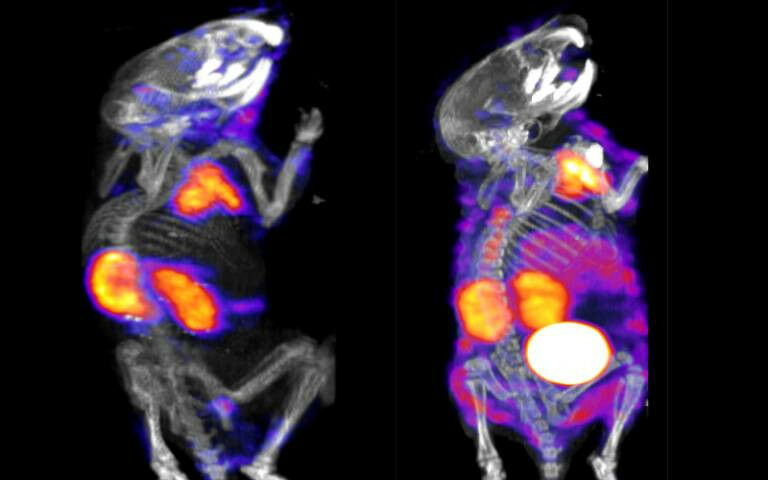
Scan of mice receiving mRNA treatment - Credit: Research team.
Scan of mice receiving mRNA treatment - Credit: Research team. By exploiting the technology used in Covid-19 vaccines, a team led by UCL, King's College London and Moderna scientists has created an effective therapy for a rare disease, in a study in mice, demonstrating the technology's potential therapeutic use in people. The research, published in Science Translational Medicine , found that messenger RNA (mRNA) could be used to correct a rare liver genetic disease known as argininosuccinic aciduria in a mouse model of the disease. Argininosuccinic aciduria is an inherited metabolic disorder that affects how the body breaks down protein - potentially leading to high levels of ammonia in the blood. Patients affected by the disease are found to also experience an imbalance of glutathione regulation, which is important for liver detoxification. The condition occurs in approximately one in 100,000 newborns. Over the coming years, the team aims to trial the therapy in people.
TO READ THIS ARTICLE, CREATE YOUR ACCOUNT
And extend your reading, free of charge and with no commitment.