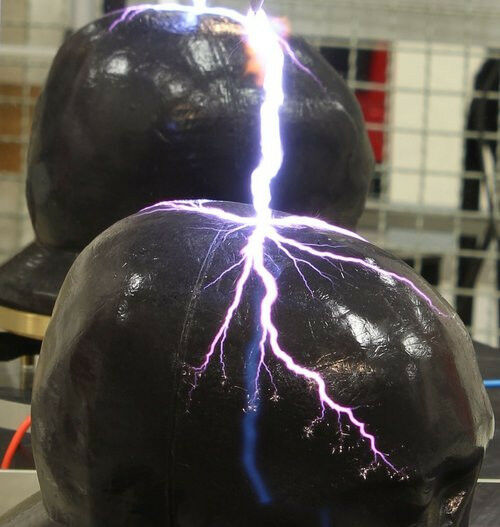
Long exposure of an experiment with a flash discharge on an artificial head
Long exposure of an experiment with a flash discharge on an artificial head Research carried out by the Technische Universität Ilmenau has shown that rainwater on the scalp can reduce the damage caused by direct lightning strikes to the head. In comparison to dry scalps, wet scalps are less severely struck and the wetness also reduces the electrical current to which the brain is exposed. The scientists concluded that a person would have a significantly higher chance of survival in the event of a direct lightning strike to the head. The results of the research conducted by the Biomedical Engineering Group and the Group for Lightning and Surge Protection at TU Ilmenau have just been published in the renowned journal Springer Nature Scientific Reports. The scientists then carried out a comparative experiment: One head was exposed to the electrical discharges in a dry state, while another had previously been sprayed with artificial rainwater. On the wet artificial head, there were fewer perforations and less severely damaged areas in the vicinity of the lightning strikes. In addition, the recorded currents to which the brain was exposed were lower on the wet head than on the dry one, which is why it was exposed to much less stress.
TO READ THIS ARTICLE, CREATE YOUR ACCOUNT
And extend your reading, free of charge and with no commitment.