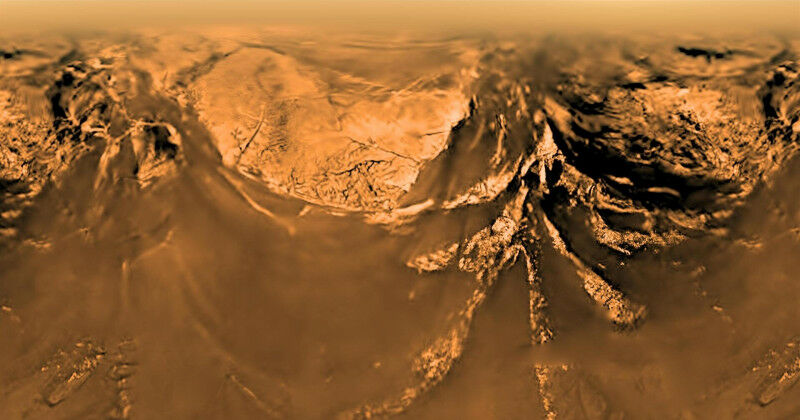
This poster shows a flattened (Mercator) projection of the Huygens probe’s view of Saturn’s moon Titan from 10 kilometers altitude. The images that make up this view were taken on Jan. 14, 2005, with the descent imager/spectral radiometer onboard the European Space Agency’s Huygens probe. The Huygens probe was delivered to Titan by the Cassini spacecraft, which is managed by NASA’s Jet Propulsion Laboratory, Pasadena, Calif. NASA supplied two instruments on the probe, the descent imager/spectral radiometer and the gas chromatograph mass spectrometer. (ESA/NASA/JPL/University of Arizona)
This poster shows a flattened (Mercator) projection of the Huygens probe's view of Saturn's moon Titan from 10 kilometers altitude. The images that make up this view were taken on Jan. 14, 2005, with the descent imager/spectral radiometer onboard the European Space Agency's Huygens probe. The Huygens probe was delivered to Titan by the Cassini spacecraft, which is managed by NASA's Jet Propulsion Laboratory, Pasadena, Calif. NASA supplied two instruments on the probe, the descent imager/spectral radiometer and the gas chromatograph mass spectrometer. (ESA/NASA/JPL/University of Arizona) - A study led by astrobiologist Catherine Neish for Western University shows the subsurface ocean of Titan - the largest moon of Saturn - is most likely a non-habitable environment, meaning any hope of finding life in the icy world is dead in the water. This discovery means it is far less likely that space scientists and astronauts will ever find life in the outer solar system, home to the four 'giant' planets: Jupiter, Saturn, Uranus and Neptune.
TO READ THIS ARTICLE, CREATE YOUR ACCOUNT
And extend your reading, free of charge and with no commitment.