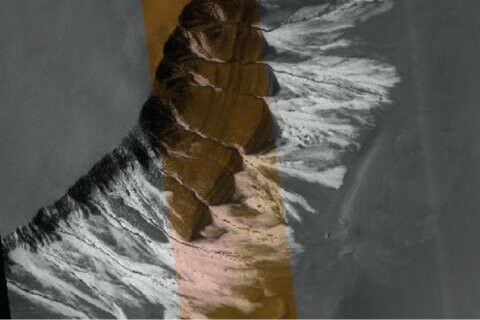
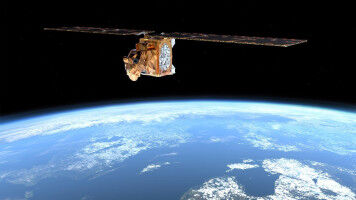
Satellite image of gully landscapes on Mars, taken by HiRISE (High Resolution Imaging Experiment), a camera on board the Mars Reconnaissance Orbiter (photo no.: ESP_039114_1115). The white CO2 ice is visible on the sides of the gullies.
Satellite image of gully landscapes on Mars, taken by HiRISE (High Resolution Imaging Experiment), a camera on board the Mars Reconnaissance Orbiter (photo no. ESP_039114_1115). The white CO2 ice is visible on the sides of the gullies. The period that liquid water was present on the surface of Mars may have been shorter than previously thought. Channel landforms called gullies, previously thought to be formed exclusively by liquid water, can also be formed by the action of evaporating CO2 ice. That is the conclusion of a new study by Lonneke Roelofs, a planetary researcher at Utrecht University. "This influences our ideas about water on Mars in general, and therefore our search for life on the planet." The results of the study were published this week in the journal.
TO READ THIS ARTICLE, CREATE YOUR ACCOUNT
And extend your reading, free of charge and with no commitment.