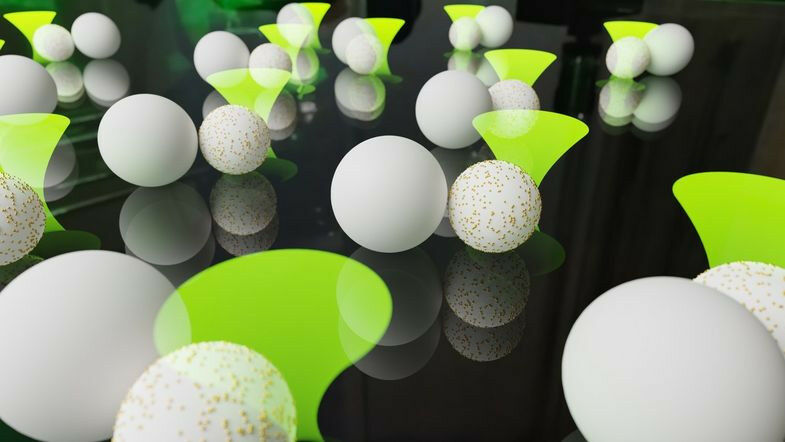
Diagram of the colloidal reservoir computer: polymer- and gold-covered particles, which are controlled by a laser and perform calculations.
Diagram of the colloidal reservoir computer: polymer- and gold-covered particles, which are controlled by a laser and perform calculations. Artificial intelligence using neural networks performs calculations digitally with the help of microelectronic chips. Physicists at Leipzig University have now created a type of neural network that works not with electricity but with so-called active colloidal particles. In their publication in the prestigious journal "Nature Communications", the researchers describe how these microparticles can be used as a physical system for artificial intelligence and the prediction of time series. "Our neural network belongs to the field of physical reservoir computing, which uses the dynamics of physical processes, such as water surfaces, bacteria or octopus tentacle models, to make calculations," says Professor Frank Cichos, whose research group developed the network with the support of ScaDS.AI. As one of five new AI centres in Germany, since 2019 "In our realization, we use synthetic self-propelled particles that are only a few micrometres in size," explains Cichos. "We show that these can be used for calculations and at the same time present a method that suppresses the influence of disruptive effects, such as noise, in the movement of the colloidal particles." Colloidal particles are particles that are finely dispersed in their dispersion medium (solid, gas or liquid).
TO READ THIS ARTICLE, CREATE YOUR ACCOUNT
And extend your reading, free of charge and with no commitment.