


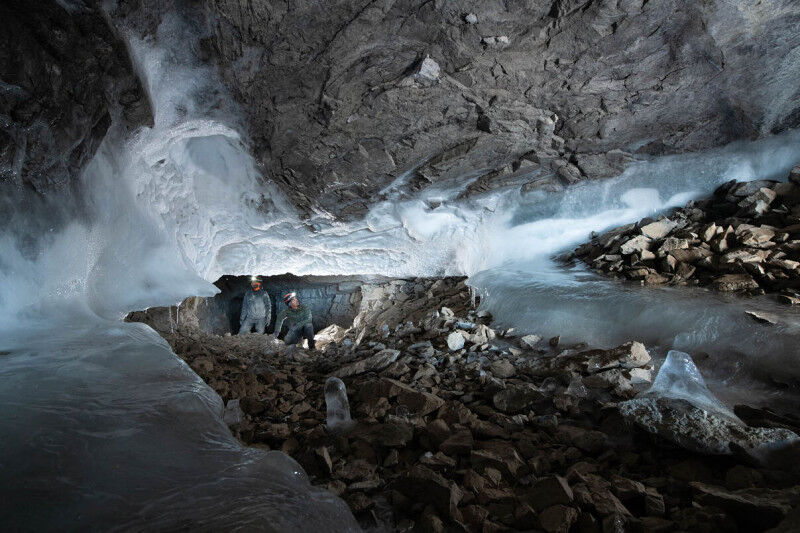
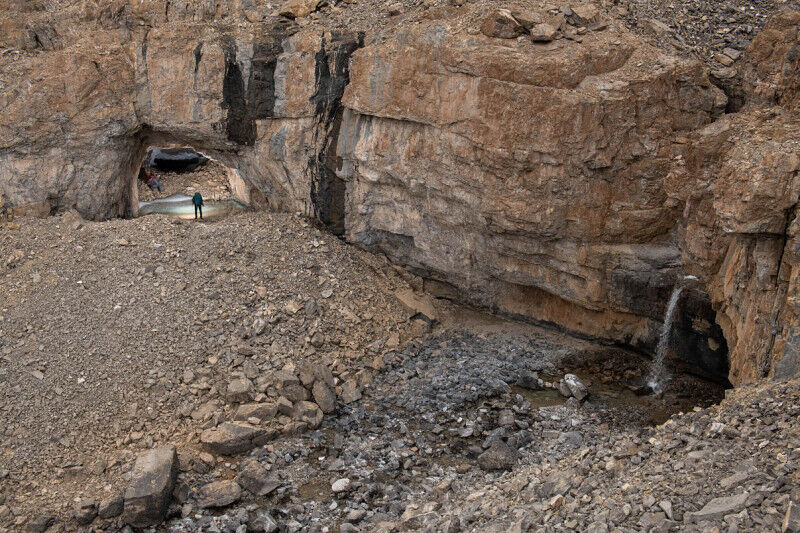
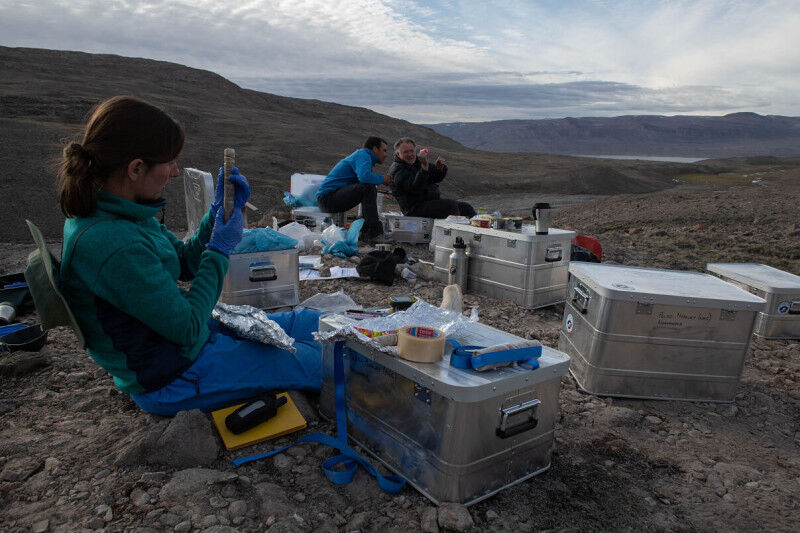
A good understanding of historical climate developments is crucial in order to better understand and predict future developments. The late Miocene, which began around 11 million years ago, is particularly revealing: This period of Earth’s history covers a time when the distribution of land and sea was similar to that of today, and both temperature and carbon dioxide levels are comparable to predictions for the coming decades. The Arctic is considered to be particularly sensitive to climate change, but little is known about its environmental conditions at that time. To close this knowledge gap, a team led by Gina Moseley went to the north coast of Greenland, one of the most remote regions on earth. The "Cove Cave" can only be reached by small plane and several days of hiking through uninhabited terrain. During the expedition, the researchers came across limestone deposits that can only form when the ground is not frozen and water can flow: "These deposits are like little time capsules for us. They show that northern Greenland was once free of permafrost and had a much wetter climate than we know today," says Gina Moseley from the Quaternary Research Group at the Institute of Geology at the University of Innsbruck.
Insights into past warm periods
The analyses provide evidence of several warm and humid phases in the late Miocene. In periods between 9.5 and 5.3 million years ago, the average annual temperature in northern Greenland was around 14 °C higher than today’s values, and the carbon dioxide concentration was at least 310 ppm. The investigations of the cave deposits show that cooling and even short-term glacier formation occurred repeatedly between the warm phases. "From this we can see that the climate reacted strongly and quickly to changing conditions," explains Moseley. Such detailed insights into the climate history of the far north were previously only possible from marine sediments. "Normally, climate records of this age come from the sea," explains Moseley. "Our study is the first to provide a high-resolution data set from the land that matches the marine data remarkably well." The climate in the far north could therefore have changed rapidly even back then, even with comparatively moderate CO2 levels. For Moseley, this is an important indication of how sensitively the Arctic system could react today: "The Arctic has never been stable in the Earth’s history. This shows how dynamic this system is and how quickly conditions can change."
Significance for the future
The study makes it clear that even small changes in carbon dioxide levels can have a major impact on the Arctic. "Our results show how sensitively the Arctic climate reacts and that every tenth of a degree counts," emphasizes Moseley. Today, CO2 levels are well above the minimum concentrations at which no permafrost was present in the late Miocene. This underlines the increasing risk of large areas of permafrost thawing: Large amounts of carbon are stored in these permanently frozen soils, which can be released as carbon dioxide and methane when they thaw. "Any limitation of warming, however small, is crucial to avoid this feedback and mitigate the consequences of climate change," emphasizes the geologist.
Click here for an animated video explaining the study: https://youtu.be/crfGzbDXHMc’si=3VzR6occYMltclhK
Publication:
Moseley, G.E., Koltai, G., Baker, J.L. et al. (2025). Late Miocene Arctic warmth and terrestrial climate recorded by North Greenland speleothems. Nat. Geosci. https://doi.org/10.1038/s41561-025-01822-0

