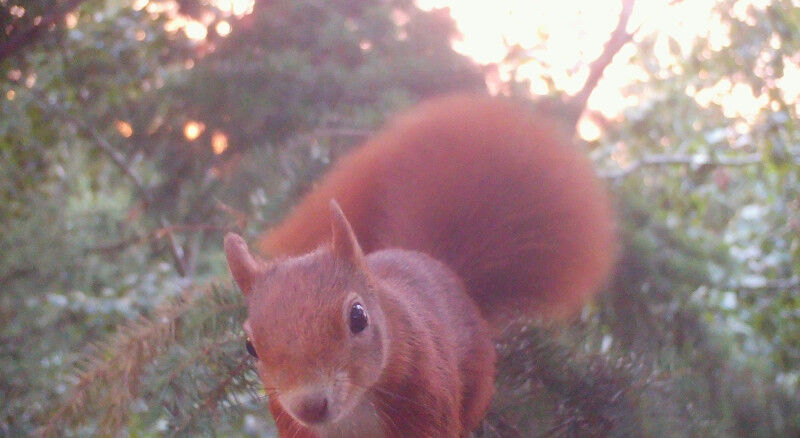
Göttingen researchers show mixed woodland boosts wildlife diversity in European forests
Can animals share the same space peacefully high above the ground in the treetops? A research team at the University of Göttingen has found that forests combining both deciduous and conifer trees make it easier for red squirrels and dormice to coexist. Using cameras placed high in the canopy, scientists discovered that red squirrels tend to prefer coniferous forests, while dormice are more commonly found in beech forests. However, in mixed forests that include both tree types, both species were observed living side by side. This suggests that mixed forests could play an important role in supporting biodiversity. The findings were published in the European Journal of Wildlife Research.

"Our results show that dormice and red squirrels are not avoiding each other. In fact, they can live together quite well in mixed forests," says lead author Pedro Mittelman, a PhD researcher in Wildlife Sciences at the University of Göttingen. "This is great news - it shows that forestry management systems combining tree species can benefit wildlife." The research team highlights the value of cultivating a mixture of trees as a way to support biodiversity, even in areas managed for timber production.

Original publication: Mittelman P, Pineda M, Balkenhol N (2025): Mixed broadleaf-conifer forests promote coexistence of red squirrels and doormice. European Journal of Wildlife Research, 71:67. DOI: 10.1007/s10344-025-01947-y