International research team measures extreme winds on an exoplanet
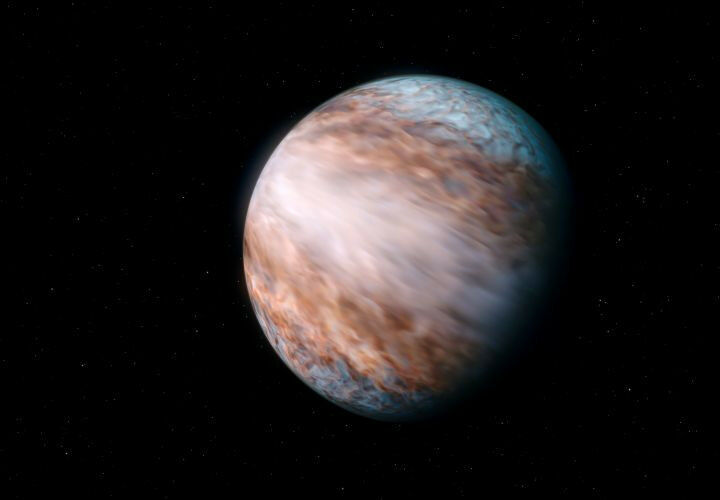
.An international research team led by the University of Göttingen has discovered extremely strong winds on the exoplanet "WASP-127b". The winds along the equator of this planet can reach speeds of up to 33,000 kilometers per hour. The results of the research help to better understand the atmosphere of planets outside our solar system. They were published in the journal Astronomy & Astrophysics.
Until a few years ago, astronomers could only measure the mass and radius of extrasolar planets - i.e. planets orbiting stars other than our sun. Now the researchers are using high-resolution infrared spectroscopy. They used it to examine the atmosphere of "WASP-127b" and found water vapor (H2O) and carbon monoxide (CO). What was surprising was that part of the atmosphere was moving towards the observers at an astonishing speed of almost 33,000 kilometers per hour, while another part was moving away from them at the same speed. The team concludes that extremely strong winds are circulating at supersonic speeds at the equator of "WASP-127b".
What is also new is that different regions on the exoplanet can be studied separately thanks to the large differences in speed - although these cannot be resolved visually as is the case with planets in our solar system. The researchers found that the jet stream on one side of the planet, at the transition between the dayside and the nightside, is slightly hotter than at the transition on the opposite side. For the poles of the planet, cooler temperatures explain the lack of a measurable signal.

The research was carried out using the CRIRES+ telescope instrument at the European Southern Observatory’s (ESO) Very Large Telescope in the Atacama Desert in Chile.
Original publication: Lisa Nortmann et al. CRIRES+ Transmission Spectroscopy of WASP-127b: Detection of Resolved Signatures of a Supersonic Equatorial Jet and Cool Poles in a Hot Planet. Astronomy & Astrophysics (2025). DOI: 10.1051/0004-6361/202450438