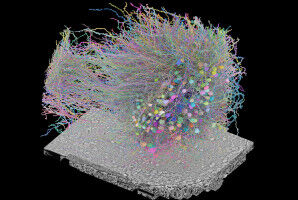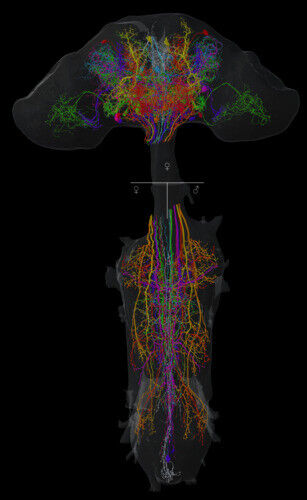
For the first time, scientists from Leipzig University and other research institutions have gained comprehensive insights into the entire nervous system of the fruit fly (Drosophila melanogaster). They have just published the first study in the scientific journal "Nature" that describes in detail the nerve cells (neurons) that span the entire nervous system of the adult fruit fly. They have also compared the entirety of the connections in the nervous system (connectome) of a female and a male animal for the first time and found differences.
currently, there are only a few electron microscopic data sets of the fruit fly connectome. None of them have so far included the complete central nervous system, i.e. the brain and nerve cord (our spinal cord). For technical reasons, the data sets previously ended at the neck," explains study leader Dr. Katharina Eichler from the University of Leipzig, describing the current state of research.
However, the nerve cells that run through the connection between the brain and the nerve cord in the neck (neck connective) are important for communicating the decisions made in the insect’s brain. However, these circuits were previously unknown. "We have now identified these neurons in three connectomes and analyzed their pathways. A female brain as well as a male and a female nerve cord data set were examined," says Eichler, who first researched the topic at the University of Cambridge and later at the University of Leipzig.
The paper describes all the nerve cells in the neck of the fruit fly that could be identified with the help of light microscopy data. This enabled the researchers to analyze the circuits of these cells as a whole. When comparing female and male nerve cells, the scientists found differences between the sexes for the first time. For example, previously unknown cells were found that only exist in one sex and are absent in the other. It was also discovered that a descending nerve cell, called aSP22, in females communicates with nerve cells that only exist in females. This explains for the first time the difference in the animals’ behavior when this neuron is active. Females stretch their abdomen, probably to lay eggs, while males bend it forward to mate.
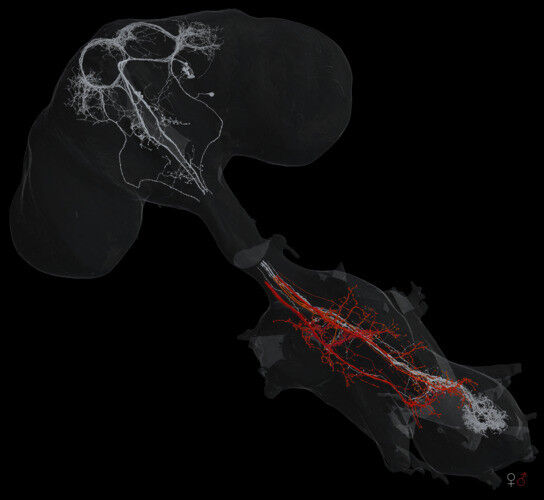
the study provides an overview of the entire connectome of the fruit fly. It is like a road map that scientists can use for orientation. Based on this, experiments to investigate the function of individual nerve cells or complete circuits can be intelligently designed, which saves a lot of work and resources," explains the biologist. As the technical problems in analyzing the nervous system of the fruit fly have now been solved, Katharina Eichler’s team is now researching two new data sets that cover the entire central nervous system of a female and a male.
Original title of the publication in Nature:
"Comparative connectomic atlas of Drosophila descending and ascending neurons", DOI: 0.1038/s41586-025-08925-z.