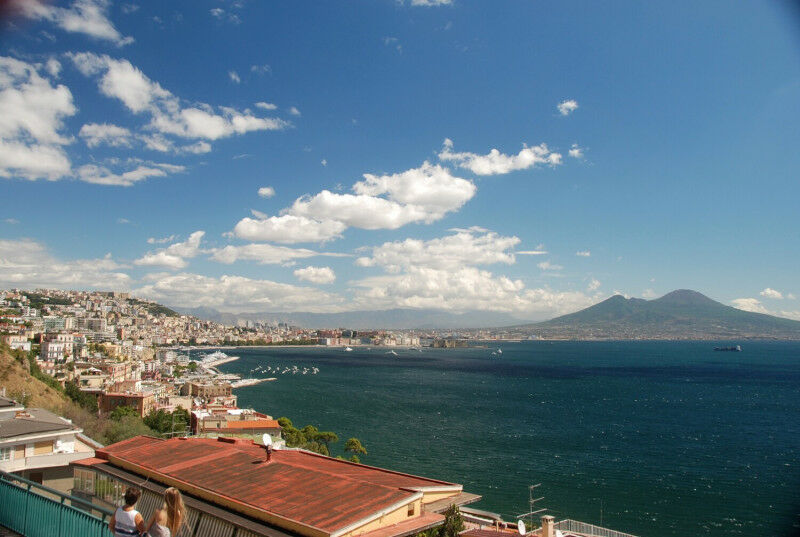
View across the Gulf of Naples from the edge of the Phlegraean Fields caldera crater to Mount Vesuvius Photo: Gerhard Wörner
International research team analyses magmatic crystals formed prior to volcanic eruption 40,000 years ago The ground in the Pozzuoli study area is very active, as shown by the columns of a Roman temple of Seraphis: the lighter stripes (about one metre above the base of the columns) mark the level of the seawater with remains of boring marine organism below. This proves that after Roman times, the temple first sunk 11 m below sea level and then rose by 12 m to its current level. The upward movements in the Phlegraean Fields have increased considerably since 2005 and can reach up to 15 centimetres per month. Photo: Gerhard Wörner How long before the actual volcanic eruption are there warning signals deep down inside the Earth? An international research team led by the University of Göttingen has investigated this question by analysing volcanic deposits from a volcanic eruption that occurred in the Phlegraean Fields near Naples 40,000 years ago. The team found that fresh magma rising from depths caused the volcano to erupt within around 60 years. However, according to the researchers, this "warning time" - meaning the time until rising magma triggers an eruption - depends largely on the magma temperature. The results were published in the Bulletin of Volcanology.
During a massive volcanic eruption about 40,000 years ago, known as the Campanian Ignimbrite, around 300 cubic kilometres of magma were released. This makes it one of the largest and most explosive eruptions in Europe in the past 100,000 years. The processes that can trigger such a volcanic eruption are recorded in the "growth rings" of magmatic crystals. These crystals are found in the magma reservoir, an underground chamber where liquid magma collects under a volcano. Such crystals grow until shortly before an eruption. The researchers examined the crystals in the deposits from the Campanian Ignimbrite eruption using an electron microprobe, a device that bombards samples with electrons and measures their chemical composition along a profile with accuracy to a thousandth of a millimetre. This enabled the team to chemically analyse the final growth phase of the crystals shortly before an eruption.
Examples of crystals that have grown in a magma at depth during its slow cooling before the eruption (black: pyroxene, white: feldspar) Photo: Gerhard Wörner "The distribution of the element barium along measured profiles at the crystal edge suggests that 40,000 years ago, a fresh supply of magma from the depths of the Earth triggered this massive eruption," explains Professor Gerhard Wörner at Göttingen University’s Department of Geochemistry and Isotope Geology. "This proves, on the one hand, that this final magma supply occurred just before the eruption. Furthermore, mathematical modelling of the measured chemical profiles shows that this process caused the much older magma already present in the Earth’s crust to erupt within just 60 years or so."
However, the timing of the advance warning for such an eruption depends largely on the temperature of the magma, which cannot be determined with certainty. "If the temperature of the magma was higher than the assumed 900 degrees Celsius, the advance warning would be significantly shorter: at around 970 degrees Celsius, most estimates range from less than four years to just one month. If the temperature was lower, for instance around 850 degrees Celsius, the advance warning time could be between eight and 380 years," says lead author Dr Raffaella Iovine, who conducted the study as part of her PhD research at Göttingen University and in collaboration with researchers from Naples.
Active release of sulphurous gases in the springs of the Solfatara volcanic crater, Phlegraean Fields. These emitted jets of steam and sulphurous fumes have intensified considerably in recent years. Photo: Gerhard Wörner Earthquake activity under the Phlegraean Fields, which has increased sharply in the last four years, has fuelled fears of a renewed eruption in the Naples region. The data now published provide the first indications of how long the re-awakened magmatic activity in the subsurface could take before an eruption. "However, our results do not indicate that an eruption will actually occur in the near future," says Wörner. "Often, underground volcanoes become restless without a subsequent eruption on the Earth’s surface. On the other hand, the volcanoes in the region of the Phlegraean Fields have been repeatedly active for over 300,000 years, often only a few hundred years apart.
Original publication: Raffaella Silvia Iovine et al. Insights into magma reactivation times prior to a catastrophic highly explosive event: the Campanian Ignimbrite eruption (Campi Flegrei, Italy). Bulletin of Volcanology (2025). DOI: 10.1007/s00445-025-01812-5The JEOL electron microprobe at the Göttingen laboratory for correlative Light and Electron Microscopy (GoeLEM), which was used to conduct an additional part of the current analyses for the study. Photo: Andreas Kronz