After a SARS-CoV-2 infection, many people suffer from long Covid syndrome. Those affected suffer weakness, difficulty concentrating, shortness of breath and other physical symptoms of varying severity. Both the disease mechanisms and the treatment options have not yet been sufficiently researched.
Scientists at the Department of Nuclear Medicine at Leipzig University Hospital have discovered that a disruption of cholinergic neurotransmission could play a central role in the development of Long Covid. The spike protein of the SARS-CoV-2 virus has a high affinity for cholinergic receptors, which can lead to a blockade of these important signaling pathways in the nervous system. These mechanisms could explain not only the cognitive impairments and the so-called brain fog symptoms, but also numerous other symptoms such as fatigue, a form of weakness, shortness of breath, autoimmune reactions and vascular dysfunction.
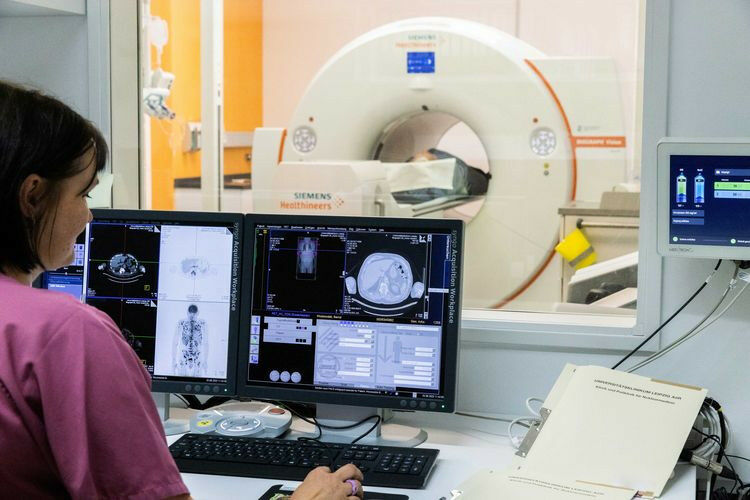
As part of the therapeutic trial, the targeted use of nicotine via the skin achieved a significant improvement in neurological symptoms, particularly speech disorders, in a Long COVID patient. These effects were clearly demonstrated using positron emission tomography (PET) imaging. First author Dr. Marco Leitzke, senior physician at the Department of Anaesthesiology, Intensive Care Medicine, Pain Therapy and Palliative Medicine at Helios Clinic Leisnig, explains: ,,We examined the patient with imaging before and after the nicotine patch therapy. The evaluation of the PET-CT/MRI images impressively shows that the nicotine molecule freed the receptors from the viral spike protein and thus enabled physiological cholinergic neutransmission again."
Further investigation of treatment with nicotine patches
Thanks to the support of the Free State of Saxony, the Clinic for Nuclear Medicine in Leipzig is now able to use a state-of-the-art whole-body PET-CT to simultaneously monitor the body from head to mid-thigh. "With the help of this most modern of all currently available PET-CT systems, we were able to visualize the patient’s nicotinic acetylcholine receptors before and after therapy as part of a treatment trial," explains Osama Sabri, senior author of the article and Director of the Clinic and Polyclinic for Nuclear Medicine. In cooperation with the Helmholtz-Zentrum Dresden Rossendorf, the scientists have developed the so-called "nicotinic receptor tracer" for imaging the receptors with PET.Under the leadership of Osama Sabri, the nuclear medicine team, in particular Swen Hesse as head of the Neuro-PET working group, together with the experts for image and quantitative data analysis, Dr. Georg Becker and Michael Rullmann, have been working for several years on imaging this special receptor system in the brain. Thanks to the new PET/CT system, the examinations can be extended to the entire body.
Based on the new findings, the research team plans to further investigate the treatment option using nicotine patch therapy in order to develop new therapeutic options for Long Covid sufferers.