


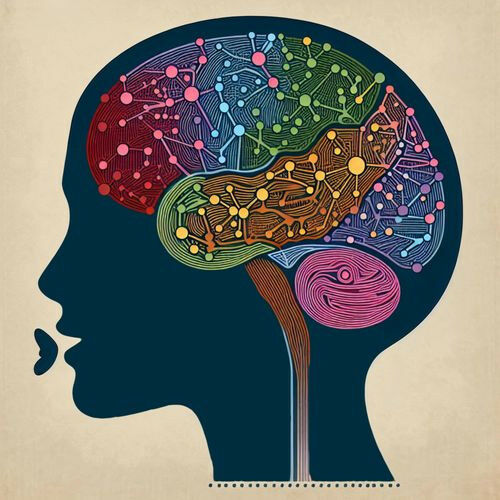
A recent study shows how the brain reorganizes itself in the first few months after a stroke in order to improve language ability. The findings help to better understand the functioning of functional networks in the brain. They also have the potential to be used in personalized therapy after a stroke in the future. Researchers from the Wilhelm Wundt Institute of Psychology at Leipzig University, the Max Planck Institute for Human Cognitive and Brain Sciences, Leipzig University Hospital and Cambridge University have discovered this. The results have now been published in the scientific journal BRAIN.
It’s a nightmare: you suffer a stroke and can no longer communicate properly afterwards. In many cases, speech recovers to a certain extent in the days and weeks afterwards. This is because the brain tries to restore speech as far as possible on its own, stimulated by its own efforts and speech therapy. The exact processes involved in speech recovery were not previously known.
"In our study, we examined stroke patients at the University Hospital over three phases: directly after the stroke and then two weeks and six months later," explains author Gesa Hartwigsen from the Wilhelm Wundt Institute of Psychology at Leipzig University and the Max Planck Institute for Human Cognitive and Brain Sciences. While previous studies focused on the activity of "classical" language centers in the brain, the authors of the present study went one step further: for the first time, they examined the interactions between different areas of the brain, called areas, at the network level. "Language involves many areas of the brain that form functional networks," says the scientist. "However, it was still unclear exactly how these brain areas work together and influence each other during language recovery."
Quick help from other network areas
The authors of the study identified three principles: "Firstly, language-specific network areas in the left hemisphere of the brain that are affected by the stroke receive functional reinforcement from other network areas very quickly," reports Hartwigsen. "These ’domain-general’ areas are present in both sides of the brain and perform cognitive support functions here." Secondly, the scientists found that "the mirror-image areas of the right hemisphere of the brain, which are normally less involved in language processing than those on the left side damaged by the stroke, step in," explains Dr. Philipp Kuhnke. These mirror-image areas are also known as homologs. And thirdly, we were able to see that network communication between the language areas in the left hemisphere of the brain also intensifies again during language recovery," says the scientist.
Adaptation processes are themselves flexible
The functional adaptation processes for regaining lost language skills changed in the patients over several months, sometimes significantly. How this happened depended, among other things, on whether the tissue damaged by the stroke was located in the anterior or posterior part of the left hemisphere of the patient’s brain. As the distribution of language-specific areas differs between right-handers and left-handers, only right-handers who had suffered a stroke in the left hemisphere were examined.

A total of 51 test subjects - 34 patients and 17 healthy control subjects - were examined at the Department of Neurology at Leipzig University Hospital under the direction of Dorothee Saur. While they were engaged in language tasks, their brain activity was measured using functional magnetic resonance imaging (fMRI). The researchers then evaluated the data using a modeling method that takes causal relationships into account. The method makes it possible to determine the direction of network communication between different areas of the brain. "Using our method, we were not only able to determine which areas are activated simultaneously, but also which part influences which other part in which recovery phase," explains Dr. Philipp Kuhnke.
Potential for later personalized therapy
"The findings hold the potential to be able to treat patients individually in the future, for example with targeted neurostimulation," says Gesa Hartwigsen. But until then, further research is needed, with even more test subjects and more extensive and detailed analyses. At the same time, the scientists are working on identifying key factors that can be used to predict a good speech recovery after a stroke shortly after the event.
Title of the original publication in BRAIN:
"Dynamic reorganization of task-related network interactions in post-stroke aphasia recovery", doi.org/10.1093/brain/awaf036
