


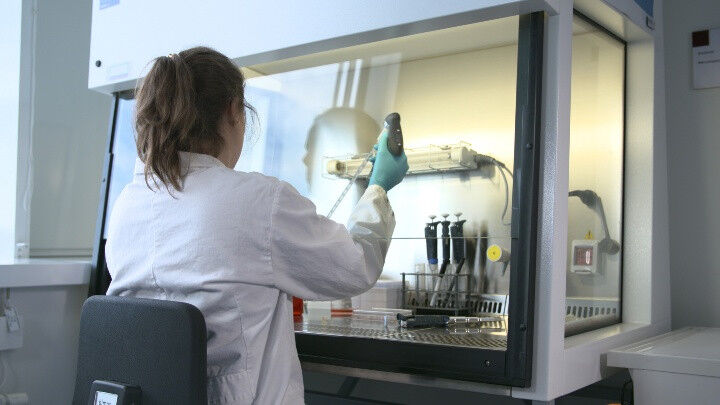
CRISPR/Cas9 was awarded the Nobel Prize in Chemistry in 2020. The process known as "gene scissors" makes it possible, among other things, to better understand how human cells function and remain healthy. Researchers at the University of Stuttgart have further developed CRISPR for this purpose. They present their CRISPRgenee method in the journal "Cell Reports Methods". DOI: 10.1016/j.crmeth.2025.101078
Cells enable all vital functions of the human body - from energy production and tissue formation to the defense against diseases. Our genes play a central role in controlling cell function: depending on which genes in a cell are currently switched on or off, different cellular processes are stimulated. "My research group is investigating how cells maintain control over their genes and thus establish and maintain a healthy cell state," says Phillip Rathert, Academic Council member and group leader at the Institute of Biochemistry at the University of Stuttgart. "In particular, we are looking at proteins that are bound to chromatin, the packaging form of our DNA in the cell nucleus. We are investigating how these proteins interact with each other to switch genes on or off at the right time."
To find this out, Rathert and his team carry out so-called genetic loss-of-function (LOF) analyses in the laboratory: "We specifically switch off individual genes or proteins in the cell in order to understand the effects of this loss of function on the cell. This allows us to draw conclusions about what role the missing gene and the protein encoded in it normally play."
State-of-the-art biotechnological "tools" are needed to carry out LOF analyses. One of these tools is CRISPR/Cas9, a method that allows scientists to modify genes in a targeted and very precise way - similar to using scissors to cut DNA at specific points. On the one hand, this raises fundamental ethical questions, but it also offers great benefits for research and medicine.
For example, when it comes to using LOF analyses to better understand how human cells function and remain healthy. "Our findings in basic research are of particular benefit to medical research, for example, they help to better understand the causes of diseases such as cancer or to find new approaches for personalized therapies," says Philipp Rathert.
Philipp Rathert and his team have succeeded in developing a novel CRISPR method that makes LOF analyses significantly more efficient and reproducible: CRISPRgenee. cRISPRgenee combines two mechanisms: silencing and cutting a target gene simultaneously in the same cell. This makes the method particularly effective for genes that are difficult to switch off using conventional methods, and it is also suitable for investigating complex cellular control processes," says Jannis Stadager , first author of the corresponding study and doctoral student in Philipp Rathert’s research group. "With the help of CRISPRgenee, not only can individual genes be switched off more efficiently and quickly, the method also enables combinatorial analyses of two different genes at the same time. This enables a more precise and robust elucidation of cellular relationships."
Publication in the journal "Cell Reports Methods"
In close interdisciplinary collaboration with Jun. Prof. Franziska Traube from the Institute of Biochemistry, Stefan Legewie from the Institute of Biomedical Genetics and Steven Johnsen from the Robert Bosch Center for Tumor Diseases, the researchers used CRISPRgenee in various biological systems, from cell proliferation to epithelial-mesenchymal transition and neuronal differentiation in human iPS cells. In the journal "Cell Reports Methods", they present their CRISPRgenee method and report on their results.
Publication:
CRISPR GENome and epigenome engineering improves loss-of-function genetic-screening approaches. Stadager J, Bernardini C, Hartmann L, May H, Wiepcke J, Kuban M, Najafova Z, Johnsen SA, Legewie S, Traube FR, Jude J, Rathert P. CRISPR GENome and epigenome engineering improves loss-of-function genetic-screening approaches. Cell Rep Methods. 2025 Jun 16;5(6):101078. doi: 10.1016/j.crmeth.2025.101078. Epub 2025 Jun 10. PMID: 40499551.
In our "Publications in Brief" series, you will find further reports that make research findings from Stuttgart publications tangible - clear, understandable and accessible to all.
