Neanderthal human occupations on the Chartres plateau (Eure-et-Loir)

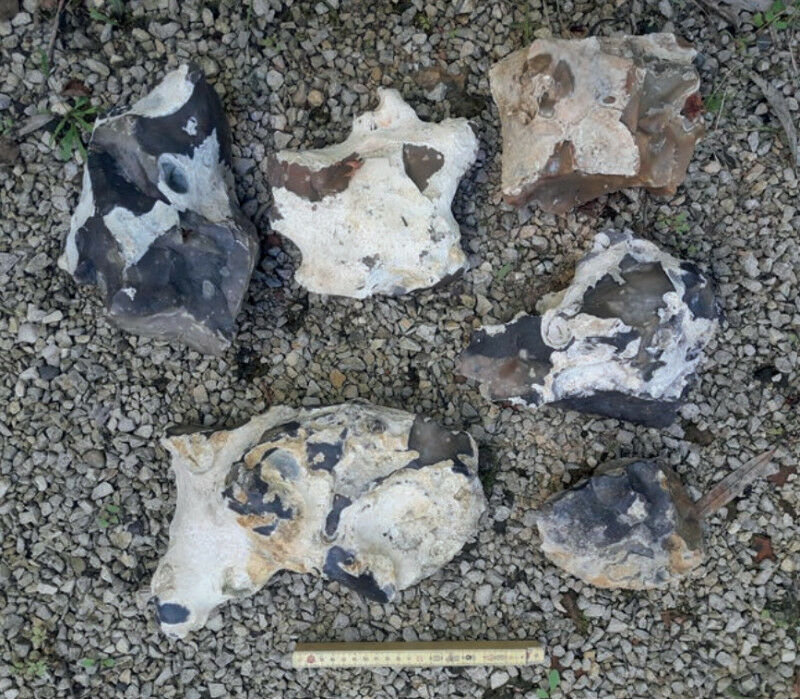
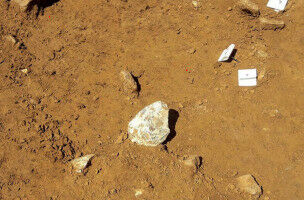
Local, highly irregular flint blocks from alterites and/or biefs overlying the l
Local, highly irregular flint blocks from alterites and/or biefs overlying the limestone bedrock of the Chartres plateau. M. Brenet, Inrap
In response to a request from the French government, and following a diagnostic study carried out in 2017, which revealed numerous flint remains, Inrap and Chartres Métropole carried out an excavation at the Enclos site (1500 m²), in Mainvilliers, west of Chartres. Studies carried out on this lithic material have revealed convincing and as yet unpublished evidence of Neanderthal human occupation of the plateau west of Chartres during a late phase of the Middle Paleolithic.

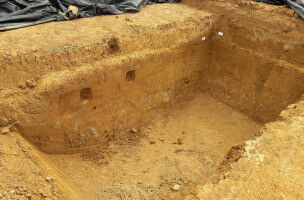
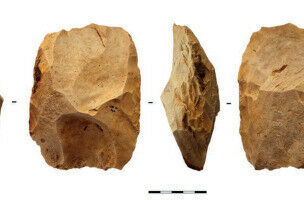
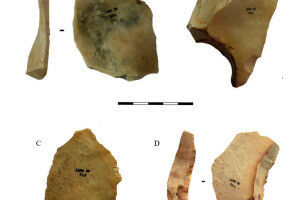
A study of the geomorphological and stratigraphic context of the Enclos site in Mainvilliers has shown that the lithic artefacts of the archaeological level were preserved in sediment colluviums that accumulated over a long period in a paleo-valley. The very sparse layer of remains yielded some 438 flint artefacts (diagnosis and excavation). The technological composition of this lithic industry indicates the knowledge, if not the coexistence, of a variety of debitage designs - Levallois diversifié, Laminaire volumétrique, sur éclat, Discoïde (?) - which are fully in line with the variability of the regional techno-complexes described for the Middle Paleolithic.

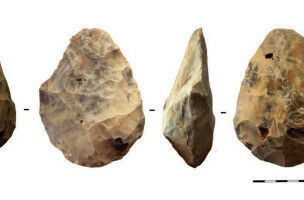
The tooling on flakes is not very standardized and dominated by simple scrapers; a few finished bifaces or fragments of bifacial tools complete the range of tools identified. Such an association of Levallois debitage with bifaces allows us to (cautiously) qualify this industry as Mousterian with bifaces. However, the weathering of the surface and cutting edges of most of the flint tools did not enable us to determine their respective modes of use, and only two bifaces, one nucleus and one flake showed identifiable traces of use: as a lighter for one of the bifaces, and as percussion tools for the other three pieces.


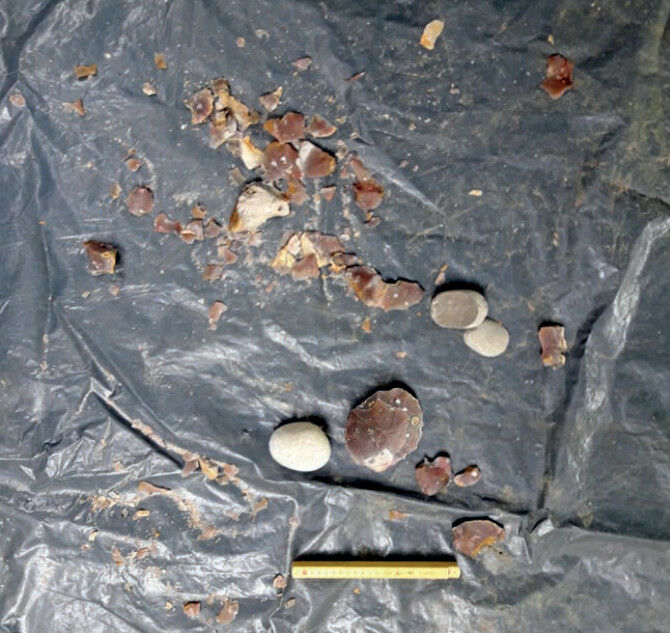
The techno-economic approach to the Enclos assemblage and its comparison with an experimental corpus and with two other lithic series recently discovered at Coulvreux (Eure et Loir) and Radray (Loiret), suggest that these remains were reworked and sorted from a site of mixed status for the production and consumption of flake tools produced on local flint. The contribution and use of mobile bifacial tools on an undetermined flint would also be attested; an export of supports produced in situ not being excluded.

Two of the dates obtained by Thermoluminescence on heated flint would potentially place Neanderthal occupations or passages at l’Enclos in a fairly wide chronological range between 57,940 and 42,820 years BC. The site’s main interest lies in the fact that it provides conclusive and as yet unpublished evidence of Neanderthal human occupation of the plateau west of Chartres during a late phase of the Middle Paleolithic. Excavation of the site has also enabled us to clarify the geomorphological context and chrono-stratigraphic framework in which it has been situated for almost 350,000 years.
Development: Chartres Aménagement
Scientific supervision: Service régional de l’archéologie (Direction régionale des affaires culturelles Centre-Val-de-Loire)

Archaeological research: Inrap
Scientific manager: Michel Brenet (Inrap)

Sector managers: Delphine Capron, Audren Chapon (Chartres Métropole)