Large-scale excavation of prehistoric levels
Archaeological finds: 6 bifaces
A first discovery of Paleolithic levels has been made by Inrap on avenue Eiffel in Tours Nord, ahead of a construction project by Bouygues immobilier, covering an area of 6,000 m². The discovery of bifaces associated with other artifacts in stratigraphy is of major importance for understanding early Paleolithic occupations in the region, and provides a nuanced insight into Neanderthal technical traditions on the banks of the Loire.


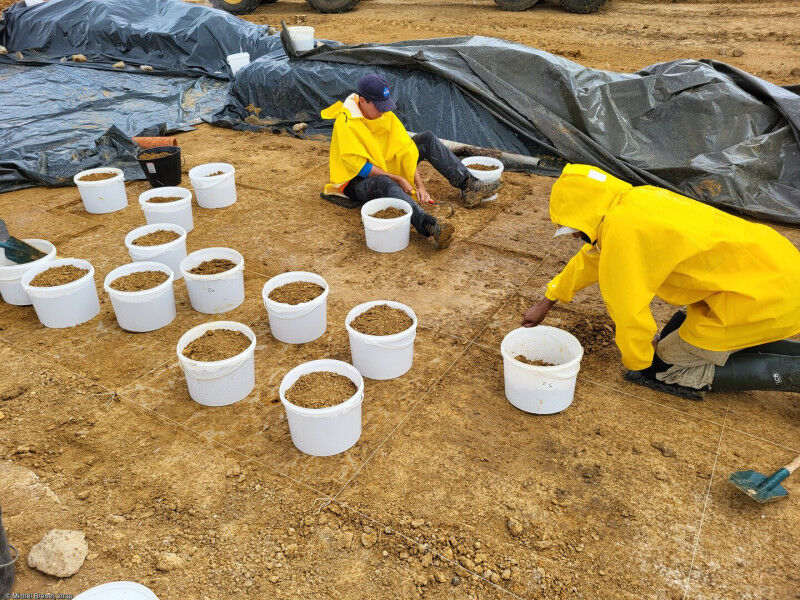
The preventive excavations, to be carried out over a 5-month period between April and August 2023, were undertaken following a diagnosis carried out in 2022. This revealed the presence of flint finds attributed to the Middle Paleolithic in a Pleistocene paleosol. The area excavated, covering 1.6 hectares, was located on a former industrial site. Most of the area, excluding polluted areas, was excavated by mechanical shovel, and 120m2 by hand. After mechanical stripping of 6,000 m², archaeologists were able to explore the stratigraphy of the site, focusing on two distinct levels of occupation.


A total of 436 stone artefacts were found, widely scattered. The site as a whole reveals a dual chronology. The site thus appears to have had two phases of human activity: one in the Early Palaeolithic (-800,000 to -300,000 years BC), the other in the Middle Palaeolithic (-300,000 to -40,000 years BC). This conclusion is the result of analyses carried out on the flint remains found, based in particular on their wear and on the technologies and typologies established
Indeed, the oldest deposit, comprising 131 pieces, was generally more buried, more worn and more patinated. The upper level, dating from the Middle Paleolithic, revealed a more diversified lithic assemblage, characterized by tools derived from Levallois and laminar debitage techniques. This discovery marks a technological evolution between the two levels of occupation
In an exceptional and unprecedented discovery, 6 bifaces from the site’s earliest chronology were found in the lower level of the site. These local flint bifaces represent an unprecedented discovery for the Early Palaeolithic in the region. as such, they provide researchers with a new perspective on the history of the Touraine region in the Early Paleolithic and on Neanderthal use of the Loire Valley.
Scientific prospects and challenges


Analyses are currently underway and will be completed by the end of 2025, in particular radiometric dating. This will enable us to determine a precise chronological framework for these discoveries. More specifically, they should make it possible to determine the use of the utensils found within Neanderthal practices. This site may have played an important role in the subsistence strategies of early Palaeolithic human groups. As such, it represents a major milestone in the study of Neanderthal human behavior and technical traditions in the Central-Western region of France. This excavation and subsequent research are shedding new light on the lifestyles and adaptations of Neanderthal populations in this part of Europe