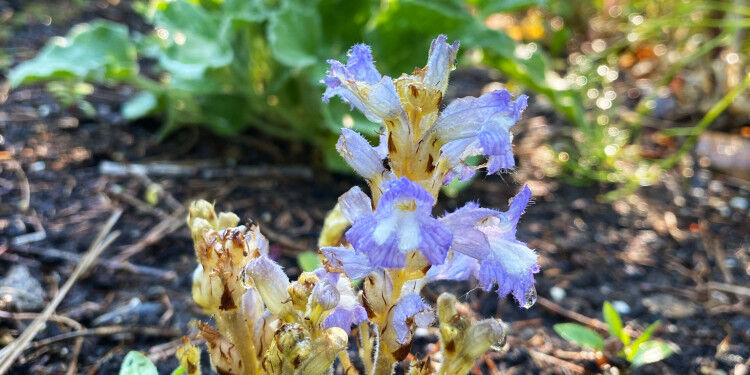
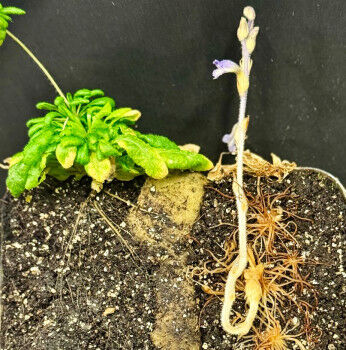
The researchers observed this phenomenon in three species of parasitic plants of the broomrape family that infest oilseeds, field beans, rice or maize plants, for example, and can cause significant yield losses. These include species that live entirely off their hosts and others that are partially independent after a period of complete dependence below-ground. All of them showed independent pre-activation of their haustoria, albeit to varying degrees. According to Susann Wicke, the ’study indicates that this mechanism may be more widespread than previously assumed.’ The results triggered a fundamental change in the previous understanding of parasitic plants. For a long time, it was widely believed that these pests only begin to develop their haustoria when a host secretes specific growth factors.
The researchers combined germination and growth experiments under strictly controlled conditions with various microscopy techniques to directly observe the development of the young parasitic plants. To determine the dissolved substances, the researchers used a particularly sensitive analysis method (UHPLC-MS/MS), which allowed them to precisely measure tiny amounts of different molecules. In addition, they recorded which genes are switched on in the cells at precisely determined points in time and control the development processes.
The study was conducted in collaboration with researchers from Humboldt University of Berlin and the University of Vienna (Austria).