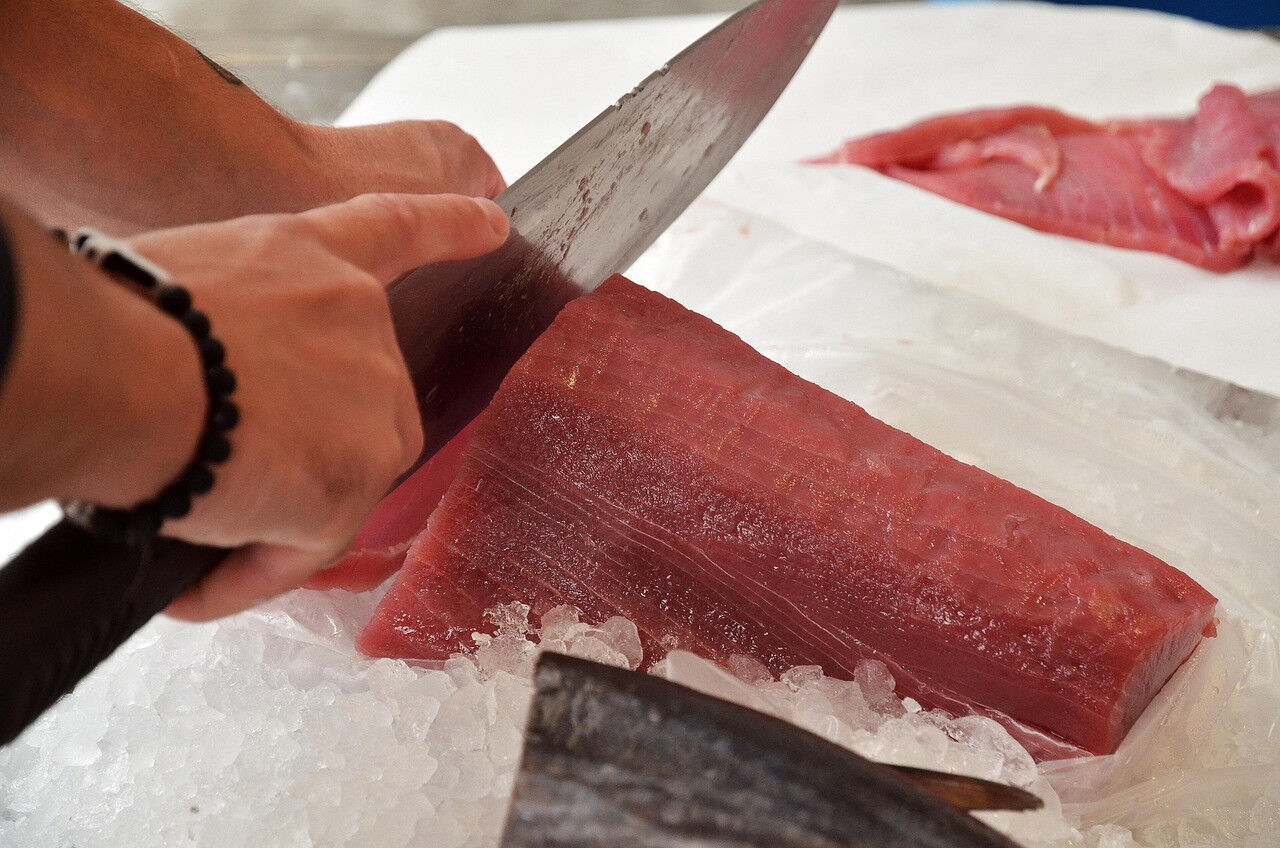
Mercury contamination is a global public health problem. This chemical element comes from both natural sources, such as volcanoes and forest fires, and human activity, including coal combustion, gold mining and the incineration of industrial and household waste. Bacteria transform mercury into methylmercury, a toxic form that accumulates in the food chain. Tuna, a top predator, accumulate mercury by consuming contaminated fish.
However, not all forms of mercury are equally toxic, and the chemical form is crucial. A study led by Alain Manceau, emeritus research director at CNRS/ENS Lyon and ESRF researcher, who has been studying mercury detoxification mechanisms in animals for many years, recommends greater precision in measuring mercury toxicity. "To assess the level of toxicity more rigorously, we would need to measure the concentration of methylmercury, which can be done routinely today, rather than the total quantity of mercury," he explains. "Otherwise, we include forms of mercury present in certain fish that are little or not harmful to the human organism."
Atlantic bluefin tuna detoxifies methylmercury
Using ESRF’s very intense X-rays, the scientific team studied how mercury was transformed in the body of Atlantic bluefin tuna. They discovered that, unlike toothed cetaceans and large seabirds, which detoxify primarily in the liver, bluefin tuna primarily use the spleen to transform methylmercury.
As the study shows, this process relies on the interaction between selenium, a trace element present in seawater, and mercury. This interaction forms a stable mercury-selenium complex that is far less toxic. Large marine predators detoxify methylmercury via a series of chemical reactions involving the reduced selenium found mainly in selenoprotein P.
To achieve these results, ESRF researchers Alain Manceau and Pieter Glatzel used a specific synchrotron technique - high spectral resolution X-ray absorption spectroscopy. They showed that some of the mercury in edible muscle is in the form of the tetraselenium complex (Hg(Sec)4), which is considered non-toxic, as it converts to inert mercury selenide in the spleen. "If the muscle contains no mercury selenide, it’s because the mercury concentration there is less abundant than in the spleen," explains Alain Manceau.
Different tuna species, different mercury concentration levels
The Atlantic bluefin tuna studied were caught along the Norwegian coast. "Specimens of this size, which can weigh up to 300 kg, are difficult to obtain, but as large predators, they are essential type specimens for this type of research study," explains Martin Wiech, a scientist at the Institute of Marine Research in Norway.
Atlantic bluefin tuna is a top predator, as is bigeye tuna, so the results of this study cannot be extrapolated to tuna species lower down the food web, which contain much less mercury.
Smaller tuna species, such as albacore, or white tuna, and skipjack tuna, commonly known as skipjack, commonly found in canned tuna, are much less contaminated.
More precise testing and appropriate recommendations
In order to better inform consumers, this study highlights the need to distinguish toxic methylmercury from less reactive mercury-selenium complexes in health analyses of mercury contamination. "Most health recommendations assume that all the mercury in fish is in the form of methylmercury," explains Alain Manceau. "However, while this is most often the case, our results show that up to a quarter of the mercury present in the edible muscle of bluefin tuna is in a much less harmful form. This proportion even reaches 90% in marlin. Health risks therefore depend not only on the total amount of mercury, but also on its chemical form."
Scientific reference:
Manceau, A., et al, Demethylation Pathway of Methylmercury in the Spleen and Peripheral Organs of Bluefin Tuna - Implications for Fish Consumers , Environmental Science & Technology , September 18, 2025. DOI : https://doi.org/10.1021/acs.est.5c08815
Scientific contact:
Alain Manceau, emeritus research director at CNRS/ENS de Lyon, researcher at ESRF - email: alain.manceau [at] esrf.fr (alain[dot]manceau[at]esrf[dot]fr)
Press contacts :
ESRF - Delphine Chenevier, Communications Director, email: delphine.chenevier [at] esrf.fr (delphine[dot]chenevier[at]esrf[dot]fr) Telephone: +33 (0)6 07 16 18 79