Archaeologists discover seven graves and artifacts around La Visitation church, revealing the history of an 18th-century cemetery.
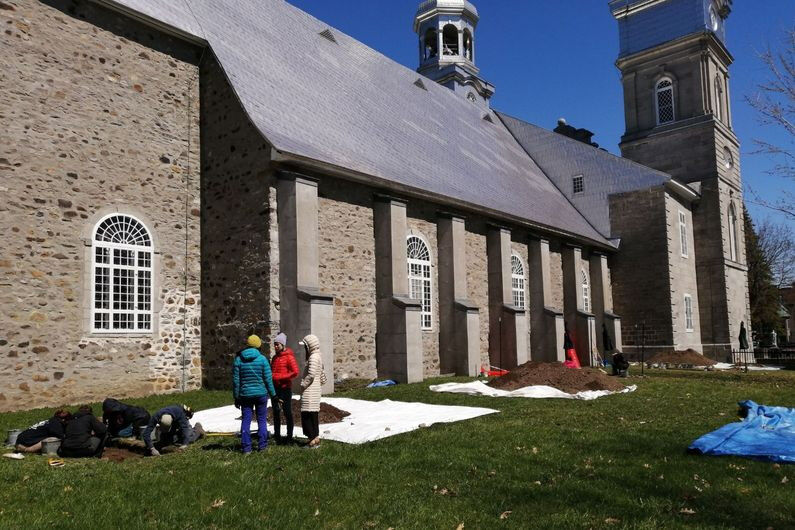
Between April 22 and May 17, a team of 15 archaeology students led by Université de Montréal professor and bioanthropologist Isabelle Ribot de Montréal, conducted an excavation campaign beneath the verdant lawns bordering the church of La Visitation-de-la-Bienheureuse-Vierge-Marie, in the Sault-au-Récollet sector. His team was made up of Jean-Christophe Ouellet, archaeologist in charge of the UdeM excavation school, Jennifer Bracewell, postdoctoral fellow, Sarai Barreiro-Argüelles, a doctoral student specializing in historical archaeology, and some 15 student volunteers.
Subsidized by the Université de Montréal’s Exploration Fund (2023-2025) and the Social Sciences and Humanities Research Council of Canada (SSHRC), this project is also the fruit of collaboration with Patrick Goulet and Philippe Barrucand of the Sault-au-Récollet parish and Emilie Desrosiers of the Ville de Montréal.
At the end of the dig, the archaeologists confirmed the presence of seven intact burials, the remains of a former parish cemetery active between 1751 and 1873.
The dig also uncovered an alignment of stones in the north-western part of the site, which may correspond to the cemetery’s former perimeter wall.
Credit: Isabelle Ribot

Thanks to previous historical and archaeological research, as well as images provided by a georadar survey carried out in 2024, the team was able to establish the areas to be explored. "A georadar survey is like running a lawnmower over a lawn. We don’t do anything destructive. The machine sends out waves, a bit like a radio, and this allows us to see if there have been any disturbances in the ground or if there are any structures," explains Isabelle.
On the east and west sides of the church, six trenches measuring 1 metre by 3 metres were opened. "We excavated from the end of April to mid-May. It was a lot of work and the weather was very bad at first. It rained non-stop. Despite everything, the results of these first surveys are very positive. In the western part, along the church, we found burials at a great depth, between 1.20 and 1.50 metres", she continues.
In the north-western part of the cemetery, the excavations also uncovered an alignment of stones that may correspond to the cemetery’s former perimeter wall.
As yet, none of the intact burials has been fully excavated. The team has merely confirmed their presence and state of preservation. The trenches have been carefully backfilled in anticipation of more in-depth excavations planned for 2026 as part of an excavation school. we left everything in place," explains Isabelle Ribot. It’s essential, from an ethical and scientific point of view, not to disturb these burials unnecessarily."
Vestiges of an eventful past
While some of the burials remain intact, other traces bear witness to significant ground reworking. In one of the test pits, archaeologists discovered a large pit containing numerous disarticulated and fragmented human bones, undoubtedly displaced during earlier work.
"There were bone fragments of adults, but also of children, sometimes even babies, mixed with artifacts such as pottery shards, fragments of children’s toys, glass or terracotta marbles. Some pieces date back to New France, others to the English period", says the researcher.
The site has revealed some much older artifacts. "When specialist firms excavated under the church forecourt a few years ago, they found objects dating back to the Archaic period, several thousand years before our era," says Isabelle Ribot. "This shows that this place attracted native groups long before the arrival of European settlers."
Material evidence of a vanished cemetery

Among the discoveries is also the presence of elements linked to the ornamentation of coffins. "We found a lot of funerary hardware: coffin handles, nails, sometimes sconces. When the graves have remained in place, these sconces can be found well aligned, because even if the coffin planks disintegrate, the sconces often remain in position. They may have sunk slightly into the ground," she explains.
She points out that in the 19th century, especially in its second half, the funeral industry expanded, leading to a proliferation of decorations on coffins. "There is a whole typology of ornaments. We’ll have to consult the catalogs of the period to see if the sconces we’ve found allow us to date certain burials more precisely."
Burials without names... for the time being
For the moment, the seven adult burials discovered remain anonymous. many people come to see us at the site, intrigued," says Isabelle. Some tell me they may have ancestors in this cemetery. But it’s almost impossible to trace all the members of the descendants or to identify precisely each person buried there."
The absence of tombstones complicates identification. "We had hoped to find some, but so far none have come to light. According to the archives, in particular those of Mr. Goulet of the parish, tombstones had been moved and left on the site, but we haven’t found them. in those days, there weren’t always tombstones. Often, they were simply small wooden crosses."
by 2026, the Université de Montréal plans to open a bioarchaeology dig school on the site. "We also hope to conduct ancient DNA analyses. We have a project to experiment with new, faster sequencing methods, directly in the field, to avoid contaminating samples," confides Isabelle Ribot, who plans to collaborate with various genetics specialists in Quebec. "Of course, this will be an experimental project. Maybe it will work, maybe it won’t. But if we manage to obtain genetic data, it could shed invaluable light on the population buried here."