


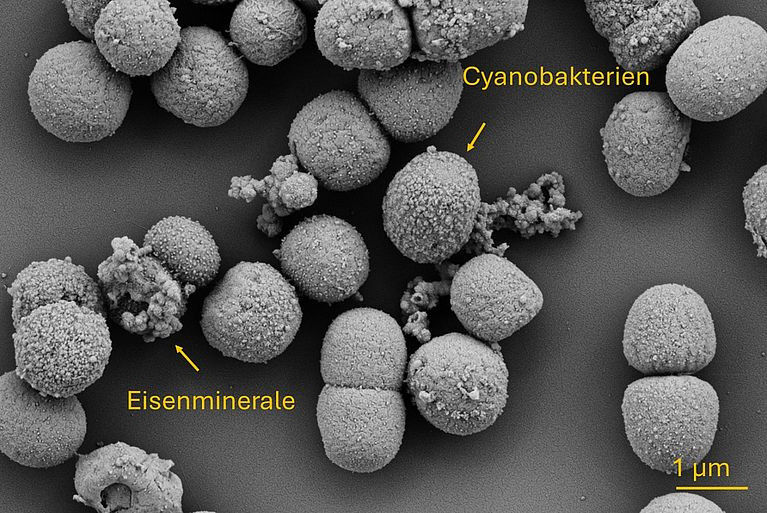
Oxygen was a troublesome waste product for cyanobacteria. As it accumulated, evolution responded, until today, oxygen is indispensable for most known life forms. "The early oceans contained a lot of dissolved iron, which reacts with oxygen to form highly reactive oxygen radicals. These reactive oxygen species, as they are called, are toxic to bacteria," explains Andreas Kappler. Until now, it was therefore assumed that oxygen radicals strongly inhibited the release of oxygen by cyanobacteria and that free oxygen only entered the atmosphere several million years after the emergence of cyanobacteria. -However, this assumption also raised the question of how cyanobacteria could survive under such conditions,- says the study’s first author, Kappler group doctoral candidate Carolin Dreher.
The role of silicate
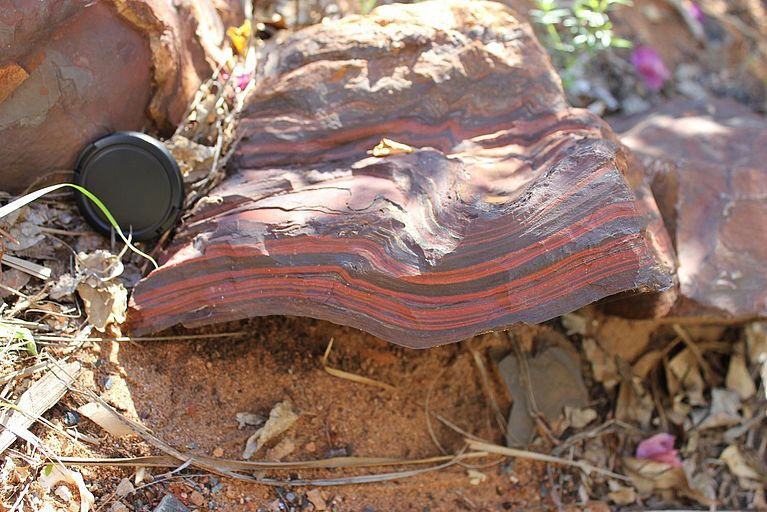
To better understand the living conditions of cyanobacteria in primeval oceans, the research team studied the growth of Synechococcus cyanobacteria in the laboratory at different concentrations of dissolved iron and silica. Silica is dissolved silicon, which was also present in large quantities in the waters of the primordial oceans. -We know this from the world’s largest iron deposits today, the banded iron formations found on several continents. There, both elements, iron and silicon, were deposited alternately in layers,- Kappler says.In the experiment, high iron concentrations increased the formation of reactive oxygen compounds and inhibited the growth of microorganisms. -However, when amounts of silicate realistic for the oceans at that time were also present in the experiments, the formation of these toxic compounds decreased significantly,- according to Carolin Dreher. Under these conditions, the cyanobacteria were able to grow and continue to produce oxygen. -High silicate concentrations apparently acted as a chemical protective mechanism that reduced the formation of harmful oxygen compounds, thus enabling the growth of cyanobacteria despite high iron concentrations,- she explains.
The effects of the diurnal switch between light and dark
Furthermore, the researchers found that the alternating phases of day and night also played an important role in oxygen enrichment. -Previous research had used continuous lighting. We found that the formation of harmful oxygen compounds was further reduced in our experiments under a daily light cycle,- reports Dreher. The researchers’ computational models based on the experimental data showed that under such conditions, oxygen-rich zones could have formed in the near-surface areas of the oceans at that time.
-This study provides fascinating new insights into the long-term development of the Earth’s atmosphere, showing that many factors must be considered,- says Professor Karla Pollmann, President of the University of Tübingen.
Publication:
Carolin L. Dreher, Olaf A. Cirpka, Manuel Schad Kurt O. Konhauser, Andreas Kappler: Survival of cyanobacteria and mitigation of Fe(II) toxicity effects in a silica-rich Archean ocean. Nature Communications, https://doi.org/10.1038/s41467-026-69826-xOfficial bulletins Disabled access Advice for international students Semester Dates Jobs Organizing Your Studies University Library Programs available Welcome Center for Scholars
ALMA Exchange Mail (OWA) Research information system FIT ILIAS, moodle Search for persons at the University (EPV) Praxisportal Timms Video Portal Webmail Uni Tübingen
University of Tübingen

Geschwister-Scholl-Platz
72074 Tübingen Germany
Contact us
