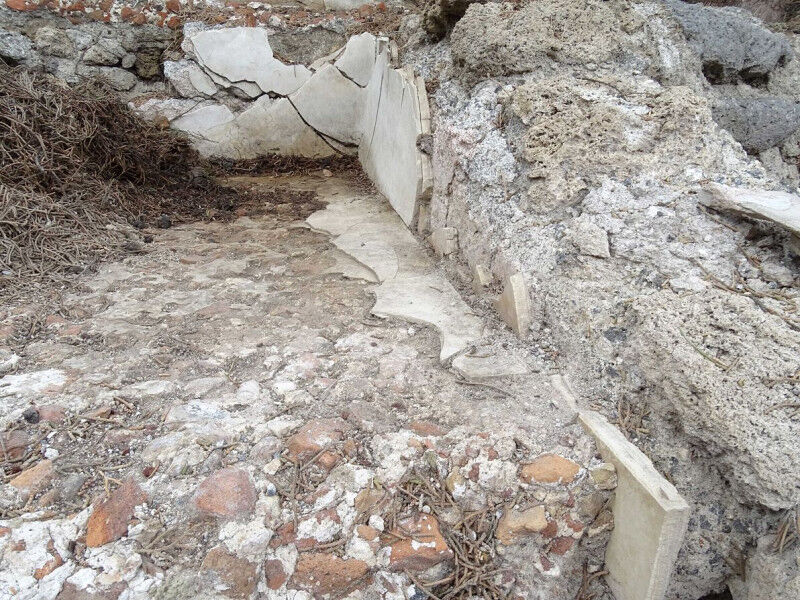
A new study by researchers from Mainz, Oxford, Berlin and Innsbruck shows that Pompeii’s early baths were much less hygienic than long assumed. Geochemical analyses of lime deposits from the city’s wells and pools reveal severe contamination and shed light on the ancient water supply in Pompeii. Innsbruck geologist Christoph Spötl was involved in the study published in the scientific journal PNAS.
The city of Pompeii was buried by an eruption of Mount Vesuvius in 79 AD. The city’s water supply system has now been reconstructed on the basis of limestone deposits, with a particular focus on the transition from groundwater wells to an aqueduct. "The baths were originally supplied via deep wells with lifting devices and the hygienic conditions were anything but ideal," says Gül Sürmelihindi from the Institute of Geosciences at Johannes Gutenberg University Mainz, lead author of the publication. "Over time, technological developments improved the water-lifting systems before they were replaced by an aqueduct in the first century AD, which provided more and better water and enabled more frequent water changes in the baths." In order to reconstruct the ancient water supply, the international team of researchers used isotope analyses to examine carbonate deposits that had formed in various areas of the city’s water infrastructure: in the aqueduct, the water towers, the well shafts and the pools of the public baths. "We sampled the limescale deposits layer by layer using a micro-milling machine and took material every 0.2 millimetres. These microsamples were analyzed isotopically by means of mass spectroscopy: this provides a high-resolution picture of the ancient water quality," says Christoph Spötl , head of the Quaternary Research Group at the Institute of Geology at the University of Innsbruck, describing the procedure.
Geochemical signatures in the limestone deposits
The lime deposits preserve changes in the water with astonishing precision: "With the oxygen and carbon isotope measurements, we were able to understand how the water sources and the use of the baths changed over time. This gives us information about the use of these water systems that is not preserved anywhere else," explains Spötl. For example, the researchers were able to document major differences in the way the water was supplied. "We found contrasting patterns of stable isotopes and trace elements in the carbonates of the aqueduct and in those of the wells," explains Sürmelihindi. Based on these different geochemical properties, the team was able to determine the origin of the bathing water and draw conclusions about Pompeii’s water management system and changes in the quality of the water. The wells tapped heavily mineralized groundwater from volcanic deposits, which was not only suitable as drinking water to a limited extent. This aspect fits in well with already known contexts: During the reign of Augustus, the aqueduct was built in Pompeii, making spring water of drinking water quality available in much greater quantities in Pompeii.Contaminated water
"In the so-called Republican Baths - the oldest public bathing facilities in the city, dating back to pre-Roman times around 130 BC - we were able to prove by means of isotope analysis that the bathing water came from wells and was not regularly renewed. Therefore, the hygienic condition did not meet the high hygiene standards that are usually attributed to the Romans and their bathing culture. In fact, the carbon isotope ratios indicate a high level of organic contamination in the bath water," explains Sürmelihindi. It was probably only changed once a day, which would not be surprising according to Sürmelihindi: "After all, the baths were supplied with a water-lifting machine that was driven by slaves using a kind of treadwheel."The researchers also found increased concentrations of lead, zinc and copper in the lime deposits of the baths, which indicates heavy metal contamination of the bath water. This suggests that the boilers and water pipes were replaced, causing the heavy metal concentrations to rise. The increase in stable oxygen isotopes also shows that the pools in the Republican Baths had warmer water after the refurbishment.
Evidence of volcanic activity?
The researchers also discovered peculiar, cyclical patterns in the carbon isotope ratio of the lime deposits in the fountains. One possible cause could be the fluctuating amount of volcanic carbon dioxide in the groundwater - this cyclicity could therefore provide information about the activity of Vesuvius before the eruption in 79 AD.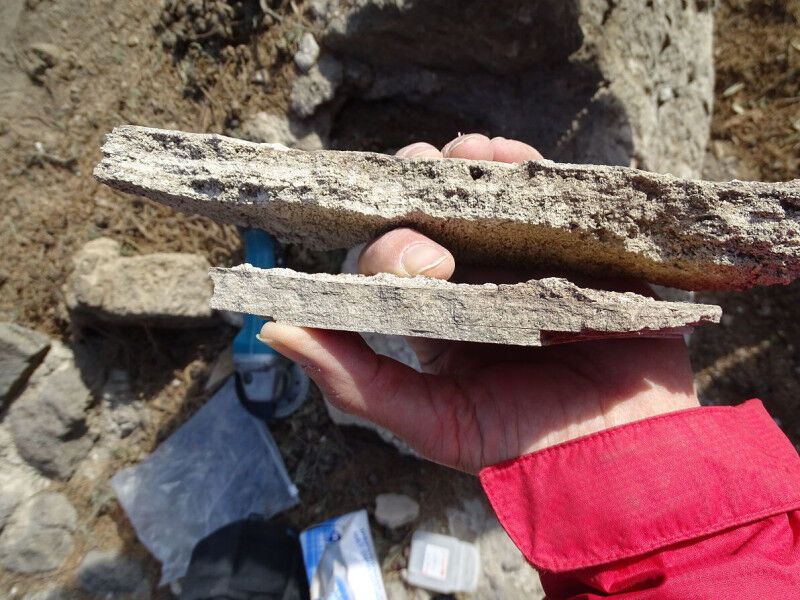
Publication:
Gül Sürmelihindi et al, Seeing Roman life through water: Exploring Pompeii’s public baths via carbonate deposits, PNAS, January 12, 2026,
DOI: 10.1073/pnas.2517276122