

Computer Science - Today
SDU is part of global initiative to bring mathematical certainty to modern computing and artificial intelligence
SDU is part of global initiative to bring mathematical certainty to modern computing and artificial intelligence
Health - Today
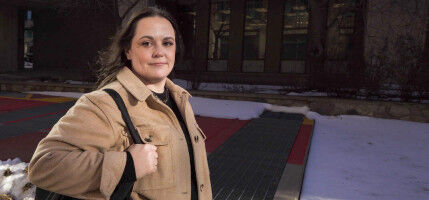
Bilingual forms improve cancer treatment understanding among people with limited English
Bilingual forms improve cancer treatment understanding among people with limited English
Health - Today
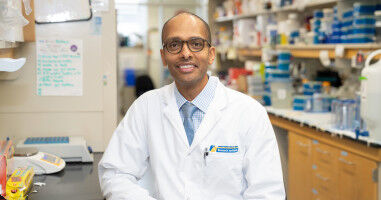
Intratumoural microbiota and the immune system: a new study from the EOC-USI Institute for Translational Research
Intratumoural microbiota and the immune system: a new study from the EOC-USI Institute for Translational Research


Event - Mar 17
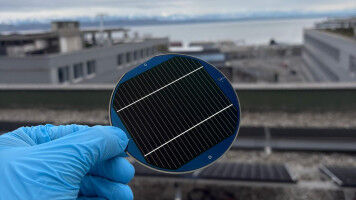
CEA Leti to Showcase Integrated Expertise In Microelectronics Reliability at IRPS 2026
CEA Leti to Showcase Integrated Expertise In Microelectronics Reliability at IRPS 2026



news
Electroengineering
Results 421 - 440 of 763.
Electroengineering - Life Sciences - 13.07.2016
Scientists closer to understanding how the ear perceives speech
The inner ear processes low-frequency sounds, important for speech and music perception, differently to high-frequency sounds, new research has found Low frequency sounds, below four kilohertz, are used by human ears for perceiving speech. However, the exact mechanism for how the inner ear processes these important sounds is poorly understood, as the organ is difficult to access in experiments.
Electroengineering - Computer Science - 07.07.2016
Robot Helps Study How Animals Moved 360 Million Years Ago
When early terrestrial animals began moving about on mud and sand 360 million years ago, their powerful tails may have been more important than scientists previously realized. That's one conclusion from a new study of African mudskipper fish and a robot modeled on the animal. Animals analogous to the mudskipper would have used modified fins to move around on flat surfaces, but for climbing sandy slopes, the animals could have benefitted from using their tails to propel themselves forward, the researchers found.
Electroengineering - 05.07.2016
Using servers for home heating
05. Summer Series on Student Projects - For his Bachelor's degree in electrical engineering, Karim Ziadé assessed the feasibility of putting data centers into residential buildings for heating purposes.
Electroengineering - Physics - 27.06.2016
Research may lead to more durable electronic devices such as cellphones
Materials scientists discover that the protective layers in chips react differently to pushes and pulls, an insight that could lead to even more durable electronic devices. Deep inside the electronic devices that proliferate in our world, from cell phones to solar cells, layer upon layer of almost unimaginably small transistors and delicate circuitry shuttle all-important electrons back and forth.
Health - Electroengineering - 20.06.2016
A tiny pump comes to the aid of weakened hearts
20. EPFL researchers have developed an innovative cardiac support system in the form of a small ring placed on the aorta.
Electroengineering - Health - 17.06.2016
World-first research to turn Brisbane River back to blue
The Nile is known for its length, the Amazon for its girth, and the Brisbane River for its murky brown colour, but one University of Queensland researcher is working to make it crystal clear. UQ School of Civil Engineering PhD student Jesper Nielsen is completing a world-first study collecting river turbulence data using a device mostly built by himself.
Life Sciences - Electroengineering - 03.06.2016
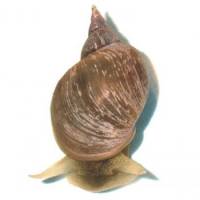
Snails reveal how two brain cells can hold the key to decision making Scientists at the University of Sussex have discovered how just two neurons in the brain hold the key to explaining how complex behavioural decisions are made. In the first-of-its-kind study scientists from the University studied the brain activity of freshwater snails and discovered how a circuit comprising of just two neurons can drive a sophisticated form of decision making.
Electroengineering - Physics - 02.06.2016
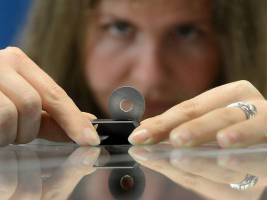
Research news Light waves might be able to drive future transistors. The electromagnetic waves of light oscillate approximately one million times in a billionth of a second, hence at petahertz frequencies. In principle future electronics could reach this speed and become 100.000 times faster than current digital electronics.
Electroengineering - Physics - 23.05.2016
A switch for light-wave electronics
A team led by Ferenc Krausz of LMU Munich and the MPI for Quantum Optics, together with theorists from Tsukuba University, has optimized the interaction of light with glass, thus improving the prospects for optically driven electronics. Light waves could in principle be used to drive future transistors.
Electroengineering - Physics - 23.05.2016
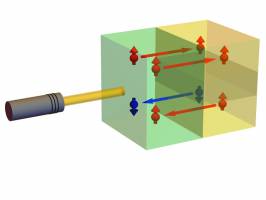
Scientists from TU Wien (Vienna) are proposing a new method for creating extremely strong spin currents. They are essential for spintronics, a technology that could replace today's electronics. A laser pulse hits nickel (green). Spin-up-electrons (red) change into silicon (yellow). Electrons with both spin-orientations change back from silicon into nickel.
Physics - Electroengineering - 20.05.2016
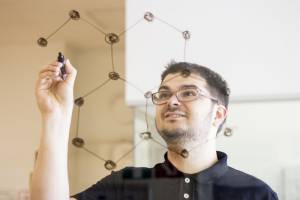
When current comes in discrete packages: Viennese scientists unravel the quantum properties of the carbon material graphene. In 2010 the Nobel Prize in physics was awarded for the discovery of the exceptional material graphene, which consists of a single layer of carbon atoms arranged in a honeycomb lattice.
Electroengineering - Chemistry - 11.05.2016
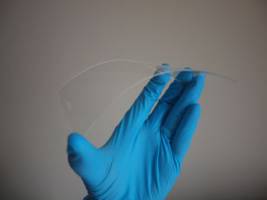
New research shows how silver could solve issues of touch-screen technologies Physicists at the University of Sussex are developing a new material for touch-screen devices that has already proved to be more flexible and to have higher conductivity than current technologies.
Physics - Electroengineering - 09.05.2016
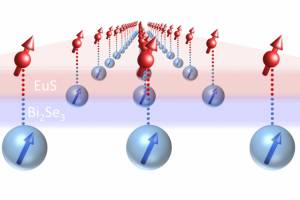
A new and unexpected magnetic effect has taken researchers by surprise, and could open up a new pathway to advanced electronic devices and even robust quantum computer architecture. The finding is based on a family of materials called topological insulators (TIs) that has drawn much interest in recent years.
Electroengineering - Chemistry - 04.05.2016
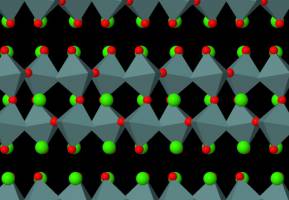
Researchers have discovered a material that could compensate for the damaging expansion that takes place when electronic components are heated. Most materials expand when heated, but a few rare materials do the opposite and contract. The contraction usually occurs only over a narrow temperature range and is not easy to tune, but now researchers have discovered a material that can be chemically tailored to either expand or contract in a precise way and over a wide temperature range.
Electroengineering - Health - 04.05.2016
Human heart cells respond less to e-cig vapour than tobacco smoke
New research has showed substantial differences in the way human heart cells respond to e-cigarette smoke and conventional cigarette smoke. Researchers from the Medical Research Council Integrative Epidemiology Unit (MRC IEU) at the University of Bristol investigated how the same type of cells as those found in the arteries of the heart, known as human coronary artery endothelial cells (HCAEC), responded when they were exposed to both e-cigarette aerosol and conventional cigarette smoke.
Electroengineering - Physics - 20.04.2016
New material combines useful, typically incompatible properties
For News Media EMBARGOED BY THE JOURNAL NATURE UNTIL NOON CENTRAL DAYLIGHT TIME ON APRIL 20, 2016 × Mild-mannered Dr. Jekyll and malicious Mr. Hyde were opposite aspects of the same man, and their story ended in tragedy because the two couldn't peacefully coexist. Most materials, too, are capable of being only one thing at a time, but a team of engineers and physicists at the University of Wisconsin-Madison have created an entirely new material in which completely contradictory properties can coexist.
Electroengineering - Event - 19.04.2016

Two engineers from the University of Bristol's Communication Systems and Networks (CSN) group, who are leaders in the field of 5th generation (5G) wireless networks, have been invited to discuss the future of wireless in Brussels and Brooklyn (US) this week [19 to 22 April]. Mark Beach , Professor of Radio Systems Engineering in the Department of Electrical and Electronic Engineering , will give an invited presentation on the Bristol Is Open Massive MIMO test bed to a European audience at the NetWorld2020 Annual Event and General Assembly 2016 in Brussels today [Tuesday 19 April].
Electroengineering - 15.04.2016
Fossil fuels could be phased out worldwide in a decade, says new study
Fossil fuels could be phased out worldwide in a decade, says new study The worldwide reliance on burning fossil fuels to create energy could be phased out in a decade, according to an article published by a major energy think tank in the UK. Professor Benjamin Sovacool, Director of the Sussex Energy Group at the University of Sussex, believes that the next great energy revolution could take place in a fraction of the time of major changes in the past.
Electroengineering - Physics - 04.04.2016
Scientists Push Valleytronics One Step Closer to Reality
Scientists with the U.S. Department of Energy's Lawrence Berkeley National Laboratory (Berkeley Lab) have taken a big step toward the practical application of "valleytronics," which is a new type of electronics that could lead to faster and more efficient computer logic systems and data storage chips in next-generation devices.
Computer Science - Electroengineering - 23.03.2016
Promotion of Artificial Intelligence and Machine Learning
Four Computer Science Groups at Freie Universität Berlin Join Forces in Dahlem Center for Machine Learning and Robotics At Freie Universität Berlin four computer science groups are combining their methods and applications to better investigate artificial intelligence and machine learning as well as additional possibilities for their application.


Computer Science - Today
SDU is part of global initiative to bring mathematical certainty to modern computing and artificial intelligence
SDU is part of global initiative to bring mathematical certainty to modern computing and artificial intelligence
Health - Today
Bilingual forms improve cancer treatment understanding among people with limited English
Bilingual forms improve cancer treatment understanding among people with limited English
Health - Today
Intratumoural microbiota and the immune system: a new study from the EOC-USI Institute for Translational Research
Intratumoural microbiota and the immune system: a new study from the EOC-USI Institute for Translational Research
Event - Mar 17
CEA Leti to Showcase Integrated Expertise In Microelectronics Reliability at IRPS 2026
CEA Leti to Showcase Integrated Expertise In Microelectronics Reliability at IRPS 2026