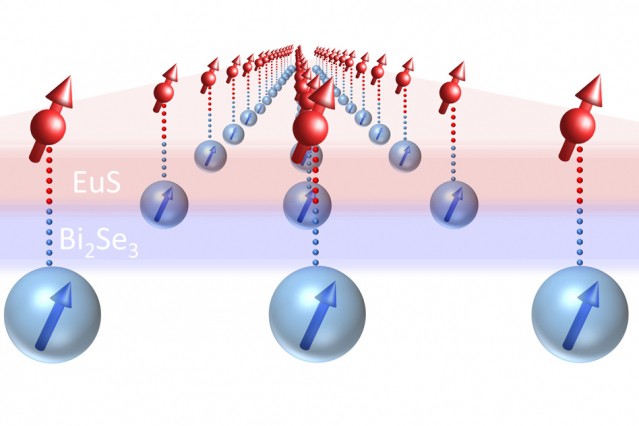
Arrows indicate the spin direction in the ferromagnetic insulator (EuS, shown in red) and topological insulator (Bi2Se3, shown in blue) at the interface between the two materials.
A new and unexpected magnetic effect has taken researchers by surprise, and could open up a new pathway to advanced electronic devices and even robust quantum computer architecture. The finding is based on a family of materials called topological insulators (TIs) that has drawn much interest in recent years. The novel electronic properties of TIs might ultimately lead to new generations of electronic, spintronic, or quantum computing devices. The materials behave like ordinary insulators throughout their interiors, blocking electrons from flowing, but their outermost surfaces are nearly perfect conductors, allowing electrons to move freely. The confinement of electrons to this vanishingly thin surface makes then behave in unique ways. But harnessing the materials' promise still faces numerous obstacles, one of which is to find a way of combining a TI with a material that has controllable magnetic properties. Now, researchers at MIT and elsewhere say they have found a way to overcome that hurdle.
TO READ THIS ARTICLE, CREATE YOUR ACCOUNT
And extend your reading, free of charge and with no commitment.