

Social Sciences - Today
Social background shapes how hard children work, according to a study by UC3M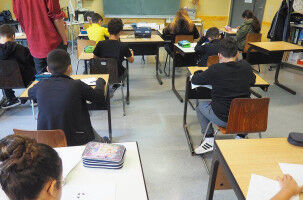
Social background shapes how hard children work, according to a study by UC3M


Art & Design - Today
The inheritance of making: Dennis Golding's art honours community and his Redfern roots
The inheritance of making: Dennis Golding's art honours community and his Redfern roots

Environment - Mar 16
UCalgary celebrates World Water Day and emphasizes the importance of equal voices in inclusive and sustainable solutions
UCalgary celebrates World Water Day and emphasizes the importance of equal voices in inclusive and sustainable solutions


Campus - GLASGOW - Mar 16
Evidence from five decades of graduates confirms Humanities skills power careers and lifelong impact
Evidence from five decades of graduates confirms Humanities skills power careers and lifelong impact
news
Mathematics
Results 541 - 560 of 565.
Life Sciences - Mathematics - 24.08.2010
Scientists Say Natural Selection Alone Can Explain Eusociality, Cooperative Social Structure in Many of Earth’s Dominant Species
FOR IMMEDIATE RELEASE Contact: Steve Bradt 617. Scientists Say Natural Selection Alone Can Explain Eusociality, Cooperative Social Structure in Many of Earth's Dominant Species Work addresses limitations of kin selection, a dominant theory since the 1960s Cambridge, Mass. August 25, 2010 - Scientists at Harvard University have sketched a new map of the "evolutionary labyrinth" species must traverse to reach eusociality, the rare but spectacularly successful social structure where individuals cooperate to raise offspring.
Mathematics - Psychology - 24.08.2010

FOR IMMEDIATE RELEASE Contact: Steve Bradt 617. Major Moral Decisions Use General-Purpose Brain Circuits to Manage Uncertainty Humans and other animals use this circuitry to make basic decisions about things like food, discounting the involvement of a specific 'moral sense' Cambridge, Mass. August 25, 2010 - Scientists at Harvard University have found that humans can make difficult moral decisions using the same brain circuits as those used in more mundane choices related to money and food.
Mathematics - Physics - 21.08.2010
Peregrine’s Solition observed at last
An old mathematical solution proposed as a prototype of the infamous ocean rogue waves responsible for many maritime catastrophes has been observed in a continuous physical system for the first time. The Peregrine 'Solition', discovered over 25 years ago by the late Howell Peregrine (1938-2007), an internationally renowned Professor of Applied Mathematics formerly based at the University of Bristol, is a localised solution to a complex partial differential equation known as the nonlinear Schrödinger equation (NLSE).
Computer Science - Mathematics - 05.08.2010

CAMBRIDGE, Mass. By combining origami and electrical engineering, researchers at MIT and Harvard are working to develop the ultimate reconfigurable robot - one that can turn into absolutely anything. The researchers have developed algorithms that, given a three-dimensional shape, can determine how to reproduce it by folding a sheet of semi-rigid material with a distinctive pattern of flexible creases.
Law - Mathematics - 28.07.2010

By Michael Bezilla Research/Penn State David H. Kaye is Distinguished Professor of Law and Weiss Family Faculty Scholar in Penn State's Dickinson School of Law, and a member of the graduate faculty of the University's Forensic Science program. He is an internationally recognized legal expert on DNA and other forms of scientific evidence and the author of " The Double Helix and the Law of Evidence," released earlier this year by Harvard University Press.
Mathematics - 26.07.2010

Having devoted his career to using statistical analysis to make accurate predictions, Professor David Spiegelhalter will this week attempt to explain how Paul the "psychic" octopus appears to be beating him at his own game. Professor Spiegelhalter, who is Winton Professor for the Public Understanding of Risk at the University of Cambridge, will be giving a free talk about his work organised by the discussion group, "Sceptics in the Pub".
Computer Science - Mathematics - 20.07.2010
’The friend of my enemy is my enemy’: Virtual universe study proves 80 year old theory on how humans interact
A new study analysing interactions between players in a virtual universe game has for the first time provided large-scale evidence to prove an 80 year old psychological theory called Structural Balance Theory. The research, published today in PNAS , shows that individuals tend to avoid stress-causing relationships when they develop a society, resulting in more stable social networks.
Mathematics - Computer Science - 19.07.2010

'The friend of my enemy is my enemy': Virtual universe study proves 80 year old theory on how humans interact New research proves paychological theory about society for the first time - News Release A new study analysing interactions between players in a virtual universe game has for the first time provided large-scale evidence to prove an 80 year old psychological theory called Structural Balance Theory.
Physics - Mathematics - 23.06.2010

A pump laser provides the energy for two dye lasers. The dye lasers are directed into a vacuum chamber where they interact with a beam of barium atoms. (Damon English/UC Berkeley) A beam of hot barium atoms exits an oven and passes through a collimator before hitting overlapping laser beams. If photons sometimes act like fermions, every once in a while a barium atom would absorb two photons and subsequently emit a flash of light.
Physics - Mathematics - 20.06.2010

Musical sounds created by longitudinal vibrations within the Sun's atmosphere, have been recorded and accurately studied for the first time by experts at the University of Sheffield, shedding light on the Sun's magnetic atmosphere. Using state-of-the-art mathematical theory combined with satellite observations, a team of solar physicists from the University have captured the music on tape and revealed the harmonious sounds are caused by the movement of giant magnetic loops in the solar corona - the outermost, mysterious, and least understood layer of the Sun's atmosphere.
Life Sciences - Mathematics - 17.05.2010

PASADENA, Calif.—The sepals of the plant Arabidopsis thaliana —commonly known as the mouse-eared cress—are characterized by an outer layer of cells that vary widely in their sizes, and are distributed in equally varied patterns and proportions. Scientists have long wondered how the plant regulates cell division to create these patterns—in other words, how it decides which and how many cells will be large, which slightly smaller, and which very small.
Life Sciences - Mathematics - 17.05.2010
Decoding network communities
A new way of finding community structure within networks - anything from social networks such as Facebook, to transport networks, political voting networks, and protein interaction networks in biology - could help us understand how people are connected and how connections change over time. The new technique, developed by a team from the University of North Carolina, University of Oxford, and Harvard University, aims to be more realistic than conventional approaches, which only capture one type of connection or a network at only one moment in time.
Physics - Mathematics - 11.05.2010

New computational techniques developed at MIT confirmed that the complex quantum effects known as Casimir forces would cause tiny objects with the shapes shown here to repel each other rather than attract. CAMBRIDGE, Mass. MIT researchers have developed a powerful new tool for calculating the effects of Casimir forces, complicated quantum forces that affect only objects that are very, very close together, with ramifications for both basic physics and the design of microelectromechanical systems (MEMS).
Mathematics - Chemistry - 23.04.2010
New computational method to uncover gene regulation
Scientists have developed a new computational model to uncover gene regulation, the key to how our body develops - and how it can go wrong. The researchers, from The University of Manchester (UK), Aalto University (Finland) and the European Molecular Biology Laboratory Heidelberg (Germany), say the new method identifies targets of regulator genes.
Physics - Mathematics - 02.03.2010
Mega-tsunami hits House of Commons
A breakthrough discovery by experts at the University of Sheffield, which sheds light on mega-tsunamis on the Sun, is set to be revealed at the House of Commons next week (Monday 8 March 2010). Solar physicists from the University will discuss their discovery of solar Transition Region Quakes to an audience of MPs both from the House of Commons and the House of Lords at the House of Commons Marquee, after being selected by the Parliamentary and Scientific Committee.
Physics - Mathematics - 25.02.2010
Scientists find an equation for materials innovation
Princeton engineers have made a breakthrough in an 80-year-old quandary in quantum physics, paving the way for the development of new materials that could make electronic devices smaller and cars more energy efficient. By reworking a theory first proposed by physicists in the 1920s, the researchers discovered a new way to predict important characteristics of a new material before it's been created.
Physics - Mathematics - 23.02.2010
Seven awarded Sloan Research Fellowships
Seven Princeton scientists have been selected to receive 2010 Sloan Research Fellowships, highly competitive grants given to outstanding scholars who are conducting research at the frontiers of their fields. They are among 118 scientists, mathematicians, engineers and economists chosen for the award from 61 colleges and universities in the United States and Canada.
Life Sciences - Mathematics - 22.02.2010
Simple math explains dramatic beak shape variation in Darwin’s finches
Cambridge, Mass. February 22, 2010 - From how massive humpbacks glide through the sea with ease to the efficient way fungal spores fly, applied mathematicians at Harvard have excavated the equations behind a variety of complex phenomena. The latest numerical feat by Otger Campàs and Michael Brenner, working closely with a team of Harvard evolutionary biologists led by Arhat Abzhanov, zeroes in on perhaps the most famous icon of evolution: the beaks of Darwin’s finches.
Mathematics - Computer Science - 13.01.2010
New record in the area of prime number decomposition of cryptographically important numbers
An international team of scientistshas obtained the prime factors of the RSA challenge number RSA-768, using the Number Field Sieve.
Health - Mathematics - 06.01.2010
Study finds H1N1 virus spreads easily by plane
Viruses love plane travel. They get to fly around the world inside a closed container while their infected carrier breathes and coughs, spreading pathogens to other passengers, either by direct contact or through the air. And once people deplane, the virus can spread to other geographical areas. Scientists already know that smallpox, measles, tuberculosis, seasonal influenza and severe acute respiratory syndrome (SARS) can be transmitted during commercial flights.


Social Sciences - Today
Social background shapes how hard children work, according to a study by UC3M
Social background shapes how hard children work, according to a study by UC3M
Art & Design - Today
The inheritance of making: Dennis Golding's art honours community and his Redfern roots
The inheritance of making: Dennis Golding's art honours community and his Redfern roots
Environment - Mar 16
UCalgary celebrates World Water Day and emphasizes the importance of equal voices in inclusive and sustainable solutions
UCalgary celebrates World Water Day and emphasizes the importance of equal voices in inclusive and sustainable solutions
Campus - GLASGOW - Mar 16
Evidence from five decades of graduates confirms Humanities skills power careers and lifelong impact
Evidence from five decades of graduates confirms Humanities skills power careers and lifelong impact