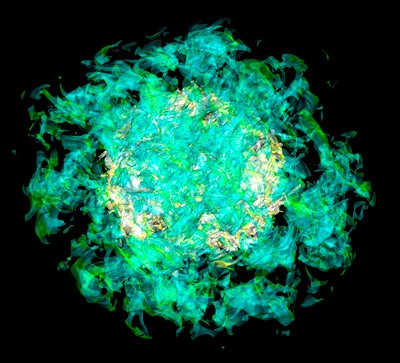
To simulate this supernova, the scientists used powerful supercomputers to employ a representation in three dimensions that allowed the various multidimensional instabilities to be expressed.
For scientists, supernovae are true superstars - massive explosions of huge, dying stars that shine light on the shape and fate of the universe. For a brief burst of time, supernovae can radiate more energy than the sun will emit in its lifetime. With the potential energy of 25 hundred trillion trillion nuclear weapons, they can outshine entire galaxies, producing some of the biggest explosions ever seen, and helping track distances across the cosmos. Now, a Princeton-led team has found a way to make computer simulations of supernovae exploding in three dimensions, which may lead to new scientific insights. Even though these mammoth explosions have been observed for thousands of years, for the past 50 years researchers have struggled to mimic the step-by-step destructive action on computers. Researchers argue that such simulations, even crude ones, are important, as they can lead to new information about the universe and help address this longstanding problem in astrophysics. The new 3-D simulations are based on the idea that the collapsing star itself is not sphere-like, but distinctly asymmetrical and affected by a host of instabilities in the volatile mix surrounding its core.
TO READ THIS ARTICLE, CREATE YOUR ACCOUNT
And extend your reading, free of charge and with no commitment.