Catching and collecting butterflies in the tropical rainforest is an exhausting task. However, the scientific analysis of the collected specimens, which are individually inspected and measured by hand, is even more laborious.
A team of scientists from Friedrich Schiller University Jena has now developed software that automates many of the steps involved in analysing the characteristics of butterflies (Lepidoptera). The results of the team from Biology and Computer Science have been published in the journal »Ecological Informatics«. The article is entitled »LEPY: A Python pipeline for automated trait extraction from standardised Lepidoptera images«.
Measuring by hand would be a mammoth task
In principle, the butterflies could be measured and analysed by hand, says Dr Gunnar Brehm, on whose idea the software was developed. However, the large number of animals alone would make this a mammoth task: In the Andes of Peru, where doctoral candidate Yenny Correa-Carmona is conducting field research, thousands of butterflies have already been collected to analyse the effects of climate change on the extremely species-rich insect communities.
These include around 1,000 species that have not yet been scientifically described, which makes the material exceptionally valuable scientifically, says Brehm. The animals are differentiated according to their size and the colouring of their patterns, among other things. Experts estimate the total number of butterflies in the world at around 180,000 known species. They are divided into diurnal and nocturnal butterflies, with the nocturnal butterflies far outnumbering the nocturnal ones with around 160,000 species.
Productive cooperation across disciplinary boundaries
The abbreviation »LEPY« stands for Lepidoptera, i.e. butterflies, and Python, a well-known programming language. Computer Science graduate Dimitri Korsch developed the technical side of the new programme with the support of Dr Paul Bodesheim from the University of Jena. Gunnar Brehm, Yenny Correa-Carmona and Dennis Böttger provided material and questions and tested the data. Brehm speaks of productive cooperation across disciplinary boundaries.
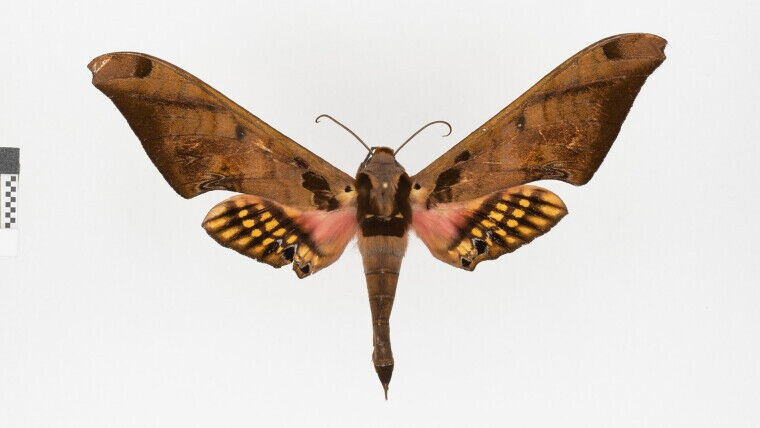
The prepared moths are first photographed with their wings outstretched in a special device that also allows images to be taken in the UV area. LEPY then extracts the outline of the butterfly from the photo and automatically calculates the length of the wings, the body length and width and the wing area. The algorithm also creates colour histograms of the animals and takes UV images into account. »Like birds, the most important predators of moths, insects also see in the UV area«, says Brehm. For the scientists, LEPY provides a new objective way of differentiating between the animals.
The system helps to monitor biodiversity
The newly developed system is available to researchers worldwide, says Brehm. The results provided by LEPY are an important contribution to answering current research questions. »The system helps us to monitor biodiversity, build global trait databases and better understand ecological relationships.« It is already apparent that the rise in temperature in the tropical lowlands due to climate change is forcing butterflies to move to higher altitudes. However, where mountains are lacking, numerous species are threatened with extinction.
Data obtained with LEPY show that species that colonise higher regions are larger on average. This could be related to the special conditions at higher altitudes, such as thinner air, which requires larger flight muscles, says Brehm. The colourfulness and contrast of the moths tends to decrease at higher altitudes. One declaration for this is the lack of suitable food plants for the caterpillars and the lack of hymenoptera, whose appearance the moths otherwise imitate in order to confuse predators.