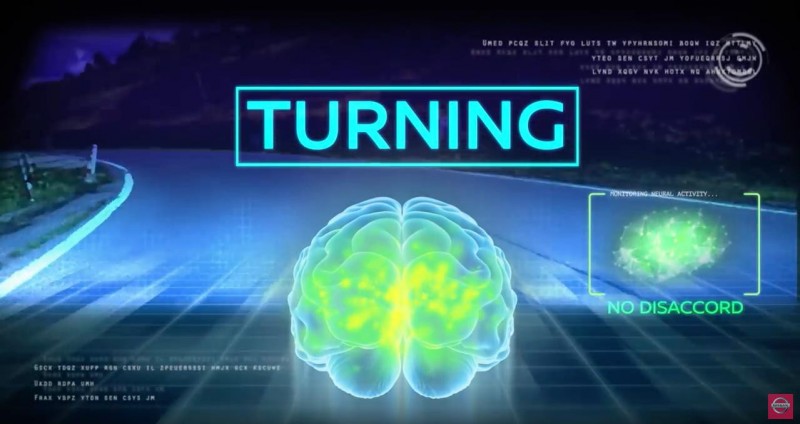
EPFL and Nissan researchers are able to read a driver's brain signals and send them to a smart vehicle so that it can anticipate the driver's moves and facilitate the driving process. Nissan recently unveiled this brain-to-vehicle (B2V) technology. Future cars will be both self-driving and manual. "We wanted to harness technology to enhance drivers' skills without interfering with the enjoyment of being behind the wheel," explains José del R. Millán, who holds the Defitech Foundation Chair in Brain-Machine Interface (CNBI). As part of a joint project with Nissan researchers based at the CNBI, the team managed to read the brain signals that indicate a driver is about to do something - such as accelerate, brake or change lanes - in order to send that information to the vehicle. With this advance notice of a few hundreds of milliseconds, the smart vehicle can anticipate the driver's movements and make the ensuing maneuver easier. The car is also equipped with sensors to monitor its environment, which means it can help the driver when traffic conditions are difficult.
TO READ THIS ARTICLE, CREATE YOUR ACCOUNT
And extend your reading, free of charge and with no commitment.
Your Benefits
- Access to all content
- Receive newsmails for news and jobs
- Post ads