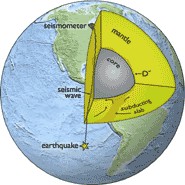
This study focusses on a mysterious layer where the mantle meets the core, a sphere of iron at the centre of the Earth 7,000 km (4400 miles) across. This part just above the core has curious properties which we can measure using seismic waves that pass through it.
Researchers at the University of Bristol reveal today that they have developed a seismological 'speed gun' for the inside of the Earth. Using this technique they will be able to measure the way the Earth's deep interior slowly moves around. This mantle motion is what controls the location of our continents and oceans, and where the tectonic plates collide to shake the surface we live on. For 2,900 km (1800 miles) beneath our feet, the Earth is made of the rocky mantle. Although solid, it is so hot that it can flow like putty over millions of years. It is heated from below, so that it circulates like water on a stove. While geophysicists know something about how the material moves by the time it reaches the top of the mantle, what goes on at the bottom is still a puzzle. However researchers need to know both to predict how the Earth's surface'our home?will behave. Andy Nowacki , at the School of Earth Sciences at Bristol University, explained: 'The only way to measure the inside of the Earth at such huge depths is with seismic waves. When a large earthquake occurs and waves travel through the Earth, they are affected in different ways, and we can examine their properties to work out what is happening thousands of miles beneath our feet, a region where we can never go. This study focusses on a mysterious layer where the mantle meets the core, a sphere of iron at the centre of the Earth 7,000 km (4400 miles) across. This part just above the core has curious properties which we can measure using seismic waves that pass through it.' This enigmatic part of the Earth is known as D?
TO READ THIS ARTICLE, CREATE YOUR ACCOUNT
And extend your reading, free of charge and with no commitment.