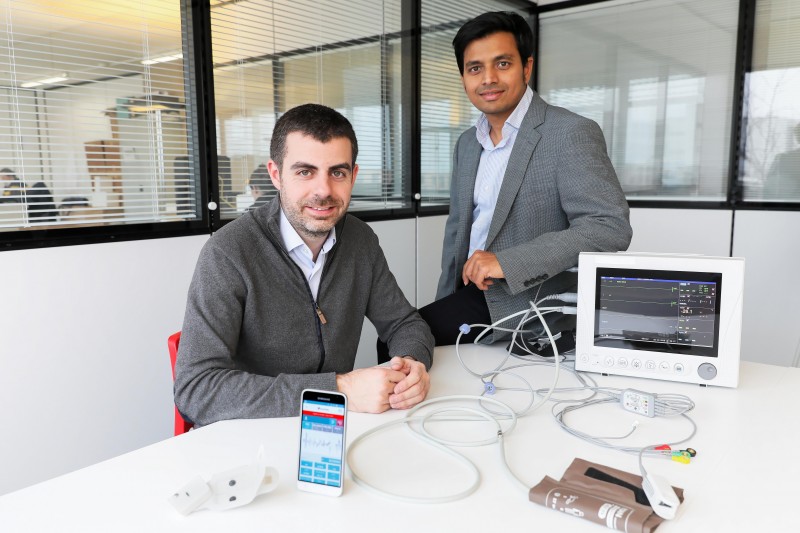
 Francisco Ricón (CTO) and Srinivasan Murali (CEO) of Smartcardia© 2018 EPFL
A small, wireless patch developed by EPFL spin-off Smartcardia can measure emergency-room patients' vital signs with the same reliability as existing systems involving cumbersome cables. After extensive testing at several hospitals, the device recently obtained the European Union's CE marking for medical devices and will be launched on the market in the coming days. To make the right decisions, emergency-room doctors need to be able to continuously monitor their patients' vital signs, including temperature, pulse, blood pressure, blood oxygen levels, cardiac rhythm and cardiac electrical activity. But existing monitoring systems typically rely on bulky sensors and an array of cables that prevent patients from being able to move comfortably. Smartcardia, an EPFL spin-off, has developed a small patch that contains a fusion of wireless sensors on a single unit, thereby eliminating the need for cables to connect the data collection devices with data storage and display equipment. An internet connection is all doctors need to be able to view and track patients' vital signs remotely and in real time, such as on a smartphone or smartwatch. The patch can be applied easily to patients' chests.
TO READ THIS ARTICLE, CREATE YOUR ACCOUNT
And extend your reading, free of charge and with no commitment.
Your Benefits
- Access to all content
- Receive newsmails for news and jobs
- Post ads