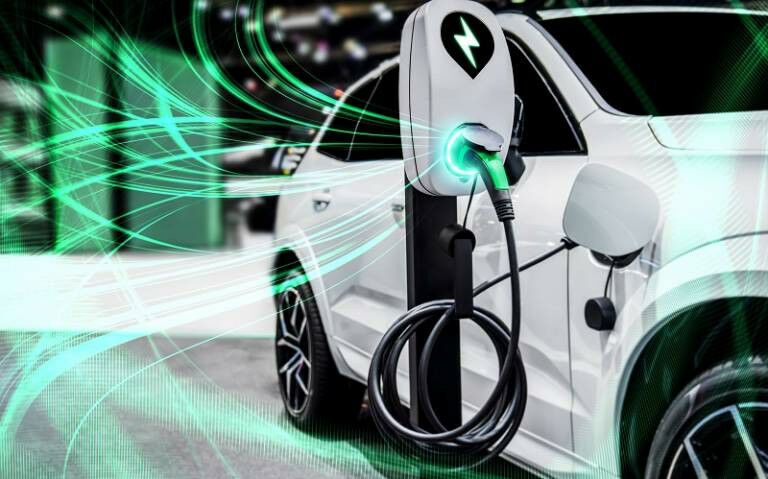
Electric vehicle at a charging station
Electric vehicle at a charging station - UCL researchers will play a bigger role in accelerating the move away from fossil fuels and towards zero-emission transport through a new partnership with Japanese manufacturer HORIBA. HORIBA will fund its new Chair in Advanced Propulsion Technologies and two PhD students to sit within the UCL Advanced Propulsion Lab (APL), which will be based at UCL East on the Queen Elizabeth Olympic Park. The lab will be dedicated to the decarbonisation of the transport sector, specialising in battery and fuel cell electric vehicles. Through the partnership, UCL and HORIBA will develop and champion new, more efficient propulsion technologies for electric vehicles and train the next generation of engineers in the sector. The APL will develop greener and more sustainable battery and fuel cell technology to lead the way towards a carbon-free future. It aims to provide the best facilities in the world to test vehicle propulsion, fuel cells and batteries - key technologies for zero-emission transport. The APL will be the first research facility in the world to develop electrochemical technologies that are then integrated and applied to a wide range of mobility and transport modes.
TO READ THIS ARTICLE, CREATE YOUR ACCOUNT
And extend your reading, free of charge and with no commitment.