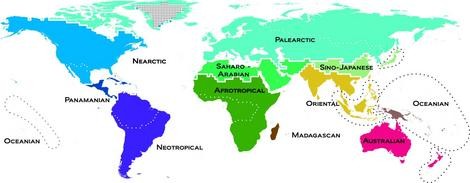
The new map of the zoogeographic realms of the world: dashed lines indicate 20 zoogeographic regions, grouped into 11 named realms. The vertebrate composition of the realms are indicated by the colours. Regions with similar colours have faunas that are evolutionarily similar.
An international research team has updated a Victorian map that has been the blueprint for our understanding of the diversity of life-forms across the world. The original map was created in 1876 by Alfred Russel Wallace, who co-discovered the theory of natural selection with Charles Darwin. Using advances in modern technology and data on more than 20,000 species, scientists have compiled the next generation map, which is published online in Science Express today. The study was led by Carsten Rahbek and a team at the Center for Macroecology, Evolution and Climate at the University of Copenhagen in collaboration with others, including Oxford University. The digital version provides fundamental information about the diversity of life on our planet, giving conservationists an essential new tool. In order to improve our understanding of life on earth, one of the big questions scientists ask is why species are distributed the way they are. Wallace divided the world into six land-based units, which largely mirror what we now know as the continental plates.
TO READ THIS ARTICLE, CREATE YOUR ACCOUNT
And extend your reading, free of charge and with no commitment.