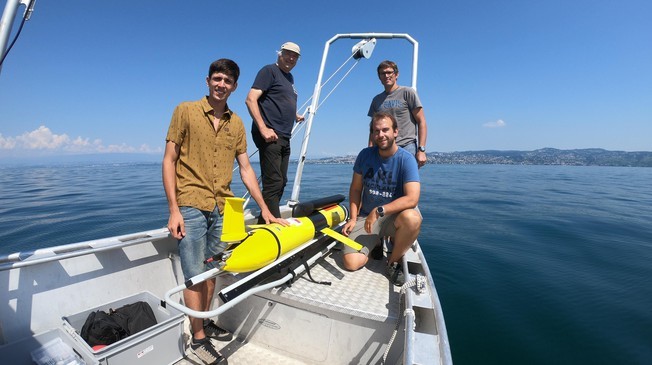
Huge systems of rotating water masses - called gyres - form in oceans and large lakes. Two EPFL laboratories, working with the University of California, Davis, are using an underwater glider to explore one such gyre in Lake Geneva and learn more about how it affects the three-dimensional structure of the aquatic ecosystem. In a first for Lake Geneva, researchers are about to gain unprecedented insight into the influence of gyres on lake ecology thanks to an underwater glider on loan from the United States. The yellow two-winged vehicle, which is able to dive down to 1,000 meters below the ocean's surface, will take measurements of Lake Geneva's turbulence for several weeks. Ocean gyres, which are fed by wind and the earth's rotation, are hundreds of kilometers across. Through centripetal force, as an example, they turn plastic wastes in the ocean into huge vortexes of garbage. Gyres occur in Lake Geneva as well, the result of the lake topographic form and the prevailing wind along the lake axis.
TO READ THIS ARTICLE, CREATE YOUR ACCOUNT
And extend your reading, free of charge and with no commitment.
Your Benefits
- Access to all content
- Receive newsmails for news and jobs
- Post ads