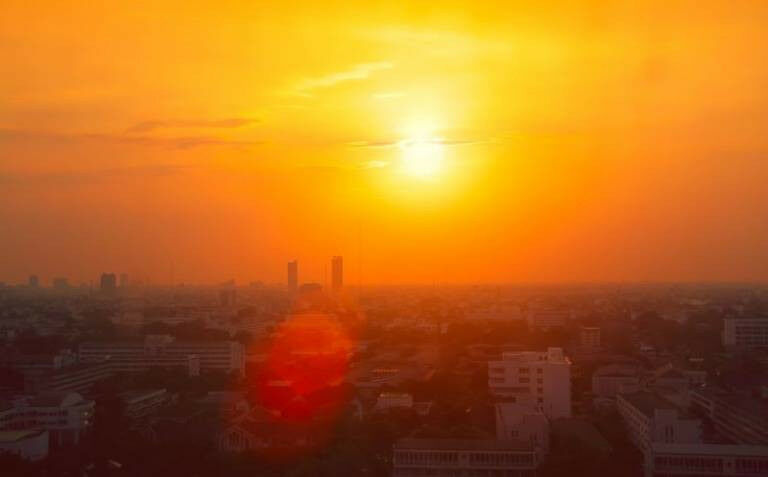
Thailand city view in heatwave summer season high temperature from global warming effect
Thailand city view in heatwave summer season high temperature from global warming effect Professor Mark Maslin (UCL Geography), Professor Priti Parikh (UCL Bartlett School of Sustainable Construction) and Dr Simon Chin-Yee (UCL Political Science) discuss the biggest talking points from COP28 and assess the key conclusions reached by delegates. The latest UN climate summit, COP28, was always going to be controversial. It was held in a state whose economy is heavily dependent on oil and gas - the United Arab Emirates. The summit president, Sultan Al Jaber, remains head of the Abu Dhabi National Oil Company and recently declared the UAE would double oil and gas output this decade. This was hardly the strong leadership to move away from fossil fuels that many had hoped for. More than 100,000 delegates were registered (twice as many as any previous COP) of which more than 2,000 were official representatives of fossil fuel companies. But COP28 started well with US$400 million (£314 million) being announced on day one for more vulnerable countries to cope with climate disasters - and talk was all about a new climate agreement including the phasing out of all fossil fuels.
TO READ THIS ARTICLE, CREATE YOUR ACCOUNT
And extend your reading, free of charge and with no commitment.