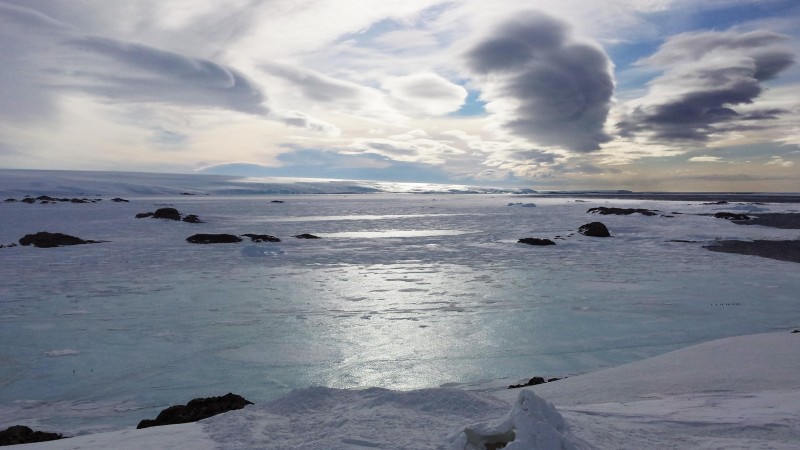
 The Antarctic ice sheet is quite flat, so the winds can gain in strength and reach as far as the coast.
A team of researchers has collected new data that shows a significant decrease in snow precipitation close to the ground in Antarctica, which has an impact on the ice sheet surface mass balance. Researchers have observed and characterized a weather process that was not previously known to occur in Antarctica's coastal regions. It turns out that the katabatic winds that blow from the interior to the margins of the continent reduce the amount of precipitation (mainly snowfall) - which is a key factor in the formation of the ice cap. By forming a very dry layer of air in the first kilometer or so of atmosphere, the winds turn the falling snowflakes during their fall directly from their solid state into water vapor in a process known as sublimation. The authors of this study used new data collected at the coast of Adélie Land over a yearlong period, together with simulations carried out using atmospheric models. They estimated that, across the continent, cumulative precipitation near the ground was 17% lower than its maximum level higher in altitude. Their measurements indicate that precipitation may be as much as 35% lower in the region around East Antarctica.
TO READ THIS ARTICLE, CREATE YOUR ACCOUNT
And extend your reading, free of charge and with no commitment.
Your Benefits
- Access to all content
- Receive newsmails for news and jobs
- Post ads