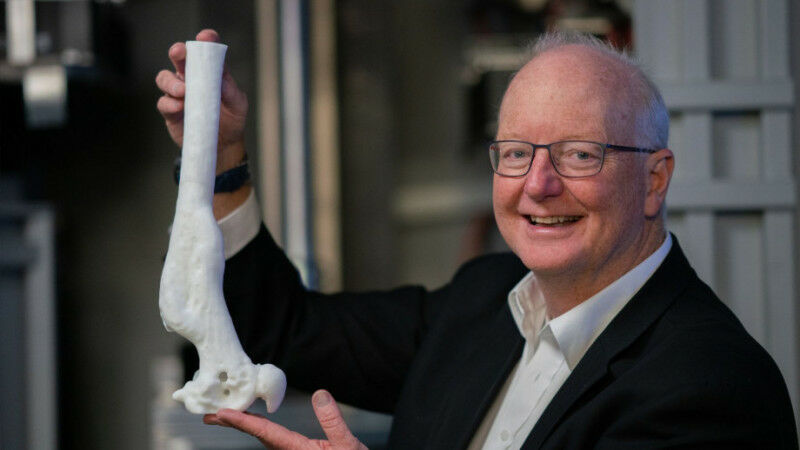
Professor Mark Knackstedt. Photo: Tracey Nearmy/ANU
Professor Mark Knackstedt. Photo: Tracey Nearmy/ANU - A new training centre hosted by The Australian National University (ANU) is upskilling the next generation of researchers in cutting-edge 3D imaging and analysis technology to help repair bones, safely store CO2, deactivate viruses on surfaces and recycle car parts among a range of critical applications. The ARC Training Centre for Multiscale 3D Imaging, Modelling and Manufacturing, M3D Innovation, is using a "disruptive" digital imaging, analysis, modelling and manufacturing technology developed at ANU for more than 15 years. The micro-imaging technology provides users with 3D "super vision" into a range of materials at scales ranging from metres to 10 nanometres - a measurement 1,000 times smaller than the width of a human hair. The technology was originally developed by a team of researchers with M3D Innovation Director, Professor Mark Knackstedt, who has won a Eureka Prize as well as an ENI award - the 'Nobel prize' for energy resources research - for his innovation. "Our centre brings together researchers from ANU and Queensland University of Technology, 15 industry partners and end users to harness the 'super-power' of advanced imaging and analysis technologies," Professor Knackstedt said. "We are building a vibrant research training environment and creating a workforce that is expert in applying the new technology to a range of new industry sectors and mentoring PhD students and early career researchers in industrial collaboration and commercialisation.
TO READ THIS ARTICLE, CREATE YOUR ACCOUNT
And extend your reading, free of charge and with no commitment.