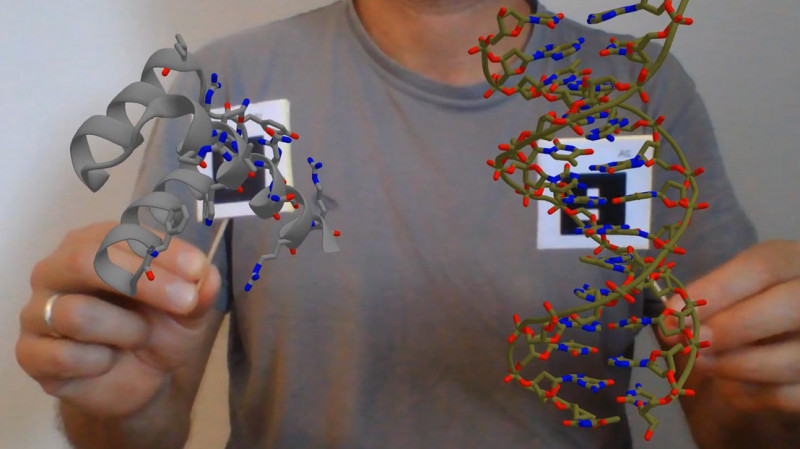
© 2020 EPFL - A website developed at EPFL allows teachers and students to explore concepts from chemistry and biology by manipulating virtual molecules in augmented reality. The activities run as web pages in regular computers, tablets, and smartphones, enabling each student to work full-time from home and school without needing complicated and expensive equipment. What are the shapes of molecules, and why? How do they move? How do proteins bind DNA to read the genetic information coded in it? How do we even work out molecular structures? Learning - and teaching - chemistry is often complicated because of the abstract nature of its many concepts. If we can't see actual atoms or molecules in everyday life, how can students then imagine, and teachers communicate, the molecular shapes, interactions, and mechanisms behind chemistry and biology? Ordinary teaching materials like books make extensive use of static, two-dimensional graphics, which often fail to communicate complex topics especially about 3D shapes and motions. Physical three-dimensional molecular models provide very intuitive ways to understand the spatial arrangement of the atoms in a molecule, or the different ways that the molecule itself moves in space. But even such models are limited: they are only useful for working with molecules but can't represent other parts of chemistry such as molecular orbitals and surfaces, and also can't comprehensively represent large biological molecules; besides, physical models are limited in the number of atoms and atom types available in the kit, and users need to build the models themselves, which, among other problems, becomes difficult for large molecules.
TO READ THIS ARTICLE, CREATE YOUR ACCOUNT
And extend your reading, free of charge and with no commitment.
Your Benefits
- Access to all content
- Receive newsmails for news and jobs
- Post ads