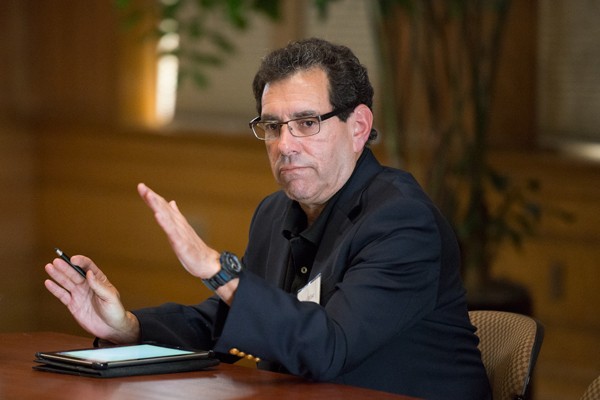
Paul Wise leads a discussion at the 5th Annual Workshop of the International Network for Research on Inequalities in Child Health.
As governments slash programs for the poor, Stanford Professor Paul Wise says there is an urgent need to discuss the impact of austerity measures on children's health. Austerity programs in several countries in North America and Europe are resulting in cuts to services for poor families that will have lasting impacts on children's health and well-being, warns Paul Wise , a Stanford expert on child health. "There are shifts in the demography of the United States, for example, that have meant reallocation of resources from the young to the old in ways never seen before," Wise said. "And at the same time, the political power of older Americans continues to be far greater than young adults and children." Wise is a senior fellow at Stanford's Freeman Spogli Institute for International Studies (FSI). Researchers at FSI, the Center on Poverty and Inequality and the School of Medicine, where Wise is also a professor, are working across disciplines to gather analytical evidence on these issues for policymakers. The state of children in developed democracies was the subject of a recent conference at Stanford that brought together leading scholars in medicine, child welfare, politics and economics. Wise hosted the group as part of his involvement in the International Network for Research on Inequalities in Child Health, or INRICH.
TO READ THIS ARTICLE, CREATE YOUR ACCOUNT
And extend your reading, free of charge and with no commitment.