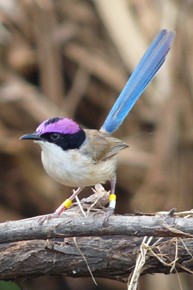
A male purple Fairy-wren. Photo by Michelle Hall/Australian Wildlife Conservancy.
The baffling question of why some animals help raise offspring which aren?t their own is closer to being answered, thanks to new research from The Australian National University. Researchers have found that birds that help care for others? nestlings gain both indirect and direct benefits and help more when the returns are greater. Dr Michelle Hall, a visiting fellow in the ANU Research School of Biology, was recently part of a long-term study on the cooperative breeding habits of purple-crowned fairy wrens. The study was led by Sjouke Kingma from the Max Planck Institute for Ornithology with Dr Anne Peters from Monash University as senior author. Dr Hall said that fairy-wrens are habitual cooperative breeders, with breeding pairs receiving help in the nest from non-breeding helpers. But in a first, the researchers found that helping in the nest boils down to both family and inheritance. 'Cooperative breeding has intrigued biologists for decades because individuals that help raise offspring that are not their own seem selfless,' she said.
TO READ THIS ARTICLE, CREATE YOUR ACCOUNT
And extend your reading, free of charge and with no commitment.