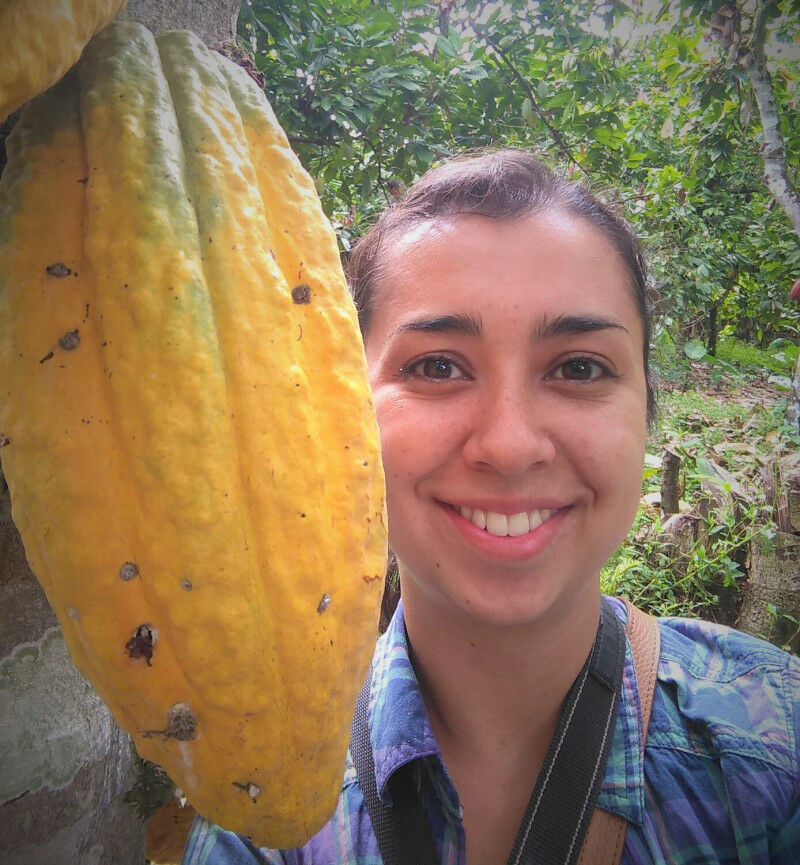
Carolina Ocampo Ariza next to a mature cacao pod, from the native Peruvian variety ’Cacao blanco de Piura’ Photo: Carolina Ocampo Ariza
Carolina Ocampo Ariza next to a mature cacao pod, from the native Peruvian variety 'Cacao blanco de Piura' Photo: Carolina Ocampo Ariza International research team led by G öttingen University finds cacao agroforestry around tropical dry forests improves biodiversity Cacao farms not only provide us with the pleasure of chocolate, but also offer potential advantages for biodiversity-friendly agriculture. The benefits to biodiversity have been widely studied in tropical rainforests, but were so far unknown in tropical dry forests. An international team of researchers led by the University of Göttingen has now reported for the first time how seasonal effects drive the presence of birds and bats - the most important consumers of insect pests - in cacao agroforests in Peru. The results were published in Agriculture Ecosystems and Environment. Tropical dry forests are globally threatened by deforestation and agriculture, and in northwestern Peru cacao is often grown near dry forest habitats. The researchers studied cacao agroforestry systems, i.e. growing cacao under shade trees, for more than one year and found that birds and bats - and mostly those that eat insects - benefit from them. -We found that tropical dry forests have unique bird and bat species, but cacao agroforestry is a good option for agricultural practices that benefit biodiversity,- reports first author Carolina Ocampo-Ariza from the Agroecology group at the University of Göttingen.
TO READ THIS ARTICLE, CREATE YOUR ACCOUNT
And extend your reading, free of charge and with no commitment.