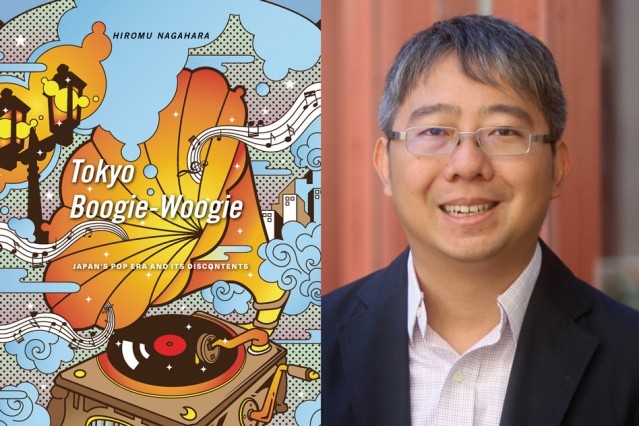
Hiromu Nagahara and his new book, ‘Tokyo Boogie-Woogie: Japan’s Pop Era and Its Discontents,’ published by Harvard University Press
In 1929, the Victor Talking Machine Company of Japan, a subsidiary of RCA, released a recording of the song 'Tokyo March,' an ode to modern life, with lines about 'dancing to jazz and drinking liqueur late into the night.' Performed by the singer Sato Chiyako, 'Tokyo March' quickly sold 150,000 copies, making it the first big pop hit in Japanese history. From that point through the 1960s, Japan's pop music industry became a powerhouse. Despite disruptions due to war and postwar reconstruction, companies churned out hundreds of what were termed 'popular songs,' or 'ryukoka,' in Japanese. By the time this pop-music boom slowed, in the 1970s, Japan had transformed itself from a traditional and hierarchical society into a nation where almost everyone described themselves as being part of the country's middle class. For Hiromu Nagahara, the Cecil and Ida Green Career Development Assistant Professor of History at MIT, these developments are related. Japanese popular music, he believes, helped create a larger common culture in the country - including a larger culture of consumption - that placed more people on common social ground.
TO READ THIS ARTICLE, CREATE YOUR ACCOUNT
And extend your reading, free of charge and with no commitment.