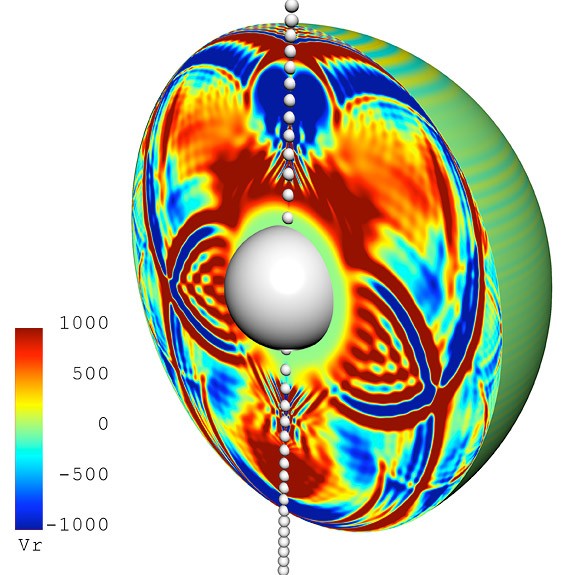
Princeton and New York University researchers have simulated the effect of a primordial black hole passing through a star. Primordial black holes are among the objects hypothesized to make up dark matter -- the invisible substance thought to constitute much of the universe -- and astronomers could use the researchers’ model to finally observe the elusive black holes. This image illustrates the resulting vibration waves as a primordial black hole (white dots) passes through the center of a star. The different colors correspond to the density of the primordial black hole and strength of the vibration. (Image by Tim Sandstrom)
by Morgan Kelly Scientists looking to capture evidence of dark matter - the invisible substance thought to constitute much of the universe - may find a helpful tool in the recent work of researchers from Princeton University and New York University. The team unveiled in a report in the journal Physical Review Letters this month a ready-made method for detecting the collision of stars with an elusive type of black hole that is on the short list of objects believed to make up dark matter. Such a discovery could serve as observable proof of dark matter and provide a much deeper understanding of the universe's inner workings. Postdoctoral researchers Shravan Hanasoge of Princeton's Department of Geosciences and Michael Kesden of NYU's Center for Cosmology and Particle Physics simulated the visible result of a primordial black hole passing through a star. Theoretical remnants of the Big Bang, primordial black holes possess the properties of dark matter and are one of various cosmic objects thought to be the source of the mysterious substance, but they have yet to be observed. If primordial black holes are the source of dark matter, the sheer number of stars in the Milky Way galaxy - roughly 100 billion - makes an encounter inevitable, the authors report. Unlike larger black holes, a primordial black hole would not "swallow" the star, but cause noticeable vibrations on the star's surface as it passes through.
TO READ THIS ARTICLE, CREATE YOUR ACCOUNT
And extend your reading, free of charge and with no commitment.