
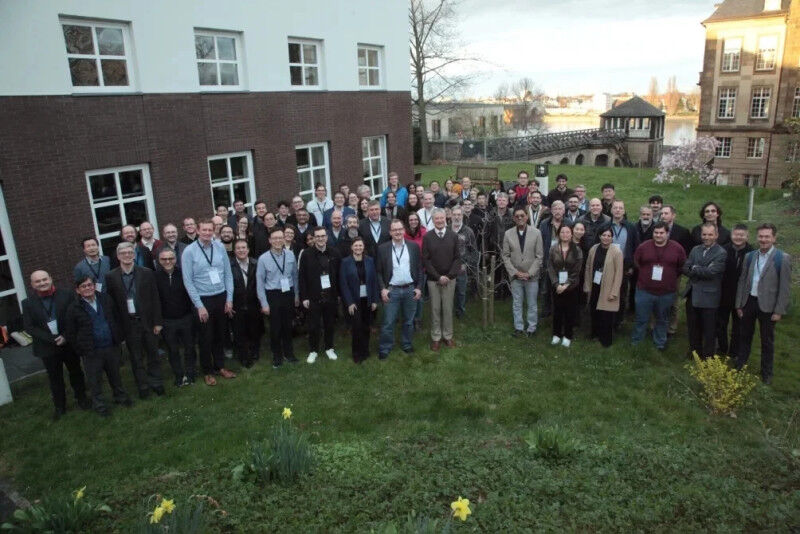
When firms like NVIDIA, Apple, AMD, IBM, Infineon and Huawei are sending their people to Bonn, we are not just talking about a niche topic for industry insiders, for instance. Rather, this is a crucial technology for the digital world, namely developing state-of-the-art microchips. Bonn recently hosted the International Symposium on Physical Design (ISPD), one of the world’s most important conferences for planning and optimizing chip design. Now in its 35th year, this was the first time it had taken place in Europe and only its second visit outside the US.
New methods in chip design-AI included
The question of how chips can be developed quicker and more efficiently has long since stopped being confined to labs and development departments. It helps to determine how powerful AI applications will become, how much energy data centers will consume and how competitive Europe will remain in what is a key industry. And it is precisely these issues that were discussed in Bonn: new methods for chip design, 3D integration, photonic integrated circuits, quantum chips-and the role that AI could itself play in developing these components in the future. The experts at the conference came up with some ideas and impressions as to what the next stages of the journey might look like.
That Bonn should have been chosen as the venue for this conference reaffirms the major role that the city is playing as a center for mathematical optimization processes in chip design. Professor Stephan Held from the Research Institute of Discrete Mathematics at the University of Bonn helped to organize the event, in which over 100 science and industry figures took part.
Decades of experience in chip design
The Research Institute of Discrete Mathematics is part of the Hausdorff Center for Mathematics Cluster of Excellence and, over the past few decades, has established itself as one of the world’s leading centers for combinatorial optimization, discrete mathematics and its uses in chip design and route planning. The aim is to devise and harness mathematical methods for practical applications in microelectronics, a research field that is vital to the global semiconductor industry.
Researchers at the University of Bonn have been working closely with IBM on chip design for nearly 40 years and have only recently expanded their partnership and ramped it up further.