 Working on methods to produce more sharply focused PET
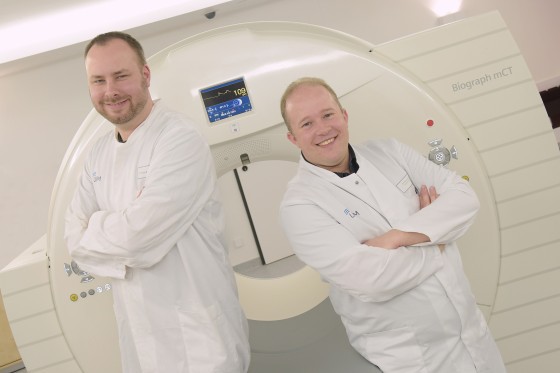
In future doctors will be able to take more sharply defined pictures of their patients' interiors when making clinical images - and entirely without any bothersome aids. Researchers at Münster University have developed a programme which enables physicians to do away with the so-called respiratory belt in positron emission tomography (PET). Up to now, patients have had not only to keep especially still during PET imaging, but also to put on such a respiratory belt. This belt measures how a patient's body moves while they are breathing. The information gathered enables the blurring caused by the breathing movements to be eliminated. "Our computer programme provides images which are just as clearly focused as those produced by the system with the belt," says Dr. Florian Büther, a medical physicist and researcher in Collaborative Research Centre 656, "Molecular Cardiovascular Imaging", at Münster University. "This simplifies clinical imaging because doctors no longer need the respiratory belt as an aid." Most amateur photographers are familiar with the problem of focusing: just one small movement and the holiday photo is blurred - and a wonderful souvenir is ruined.
TO READ THIS ARTICLE, CREATE YOUR ACCOUNT
And extend your reading, free of charge and with no commitment.
Your Benefits
- Access to all content
- Receive newsmails for news and jobs
- Post ads