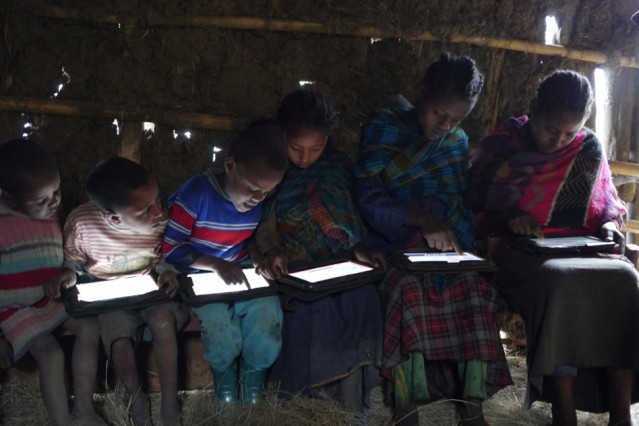
"The whole premise of our project is to harness the best science and innovation to bring education to the world’s most underresourced children," Cynthia Breazeal says. Pictured are students in Ethiopia.
For the past four years, researchers at MIT, Tufts University, and Georgia State University have been conducting a study to determine whether tablet computers loaded with literacy applications could improve the reading preparedness of young children living in economically disadvantaged communities. At the Association for Computing Machinery's Learning at Scale conference this week, they presented the results of the first three deployments of their system. In all three cases, study participants' performance on standardized tests of reading preparedness indicated that the tablet use was effective. The trials examined a range of educational environments. One was set in a pair of rural Ethiopian villages with no schools and no written culture; one was set in a suburban South African school with a student-to-teacher ratio of 60 to 1; and one was set in a rural U.S. school with predominantly low-income students. In the African deployments, students who used the tablets fared much better on the tests than those who didn't, and in the U.S. deployment, the students' scores improved dramatically after four months of using the tablets. "The whole premise of our project is to harness the best science and innovation to bring education to the world's most underresourced children," says Cynthia Breazeal, an associate professor of media arts and sciences at MIT and first author on the new paper.
TO READ THIS ARTICLE, CREATE YOUR ACCOUNT
And extend your reading, free of charge and with no commitment.