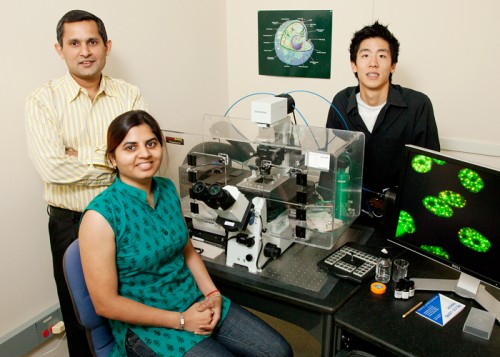
Cell and developmental biology professor Kannanganattu Prasanth, left, postdoctoral researcher Vidisha Pripathi, seated, undergraduate research assistant David Song and their colleagues found that a long non-coding RNA, MALAT1, plays a key role in pre-mRNA processing. Aberrant regulation of the MALAT1 gene is associated with several cancers, as are some of the splicing factors it regulates. Similarly, some of the genes whose pre-mRNA splicing is regulated by MALAT1 are cancer "signature genes."
CHAMPAIGN, lll. Researchers report this month that MALAT1, a long non-coding RNA that is implicated in certain cancers, regulates pre-mRNA splicing - a critical step in the earliest stage of protein production. Their study appears in the journal Molecular Cell. Nearly 5 percent of the human genome codes for proteins, and scientists are only beginning to understand the role of the rest of the "non-coding" genome. Among the least studied non-coding genes - which are transcribed from DNA to RNA but generally are not translated into proteins - are the long non-coding RNAs (lncRNAs). Before the human genome was fully sequenced, it was a "protein-centric world," said University of Illinois cell and developmental biology professor Kannanganattu Prasanth, who led the study. With the sequencing of the genome it became clear, however, that a majority of genes code for RNAs that are not translated into proteins.
TO READ THIS ARTICLE, CREATE YOUR ACCOUNT
And extend your reading, free of charge and with no commitment.