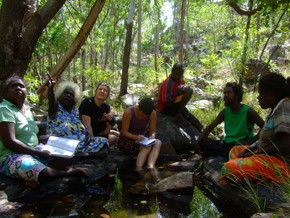
Manwurrk Rangers and ANU researchers recording Indigenous ecological knowledge in remote Arnhem land. Photo by Sam Bentley-Toon.
New conservation partnerships between Indigenous and non-Indigenous Australians are saving threatened animals, returning Aboriginal people to their ancestral homeland, discovering new types of plant species and developing novel cross-cultural ways of managing country. The inspiring projects have been featured in a special issue of the Australasian journal Ecological Management & Restoration , released yesterday and guest edited by Emilie-Jane Ens from The Australian National University. The ecologist from the Centre for Aboriginal Economic and Policy Research at ANU says that the new partnerships represent some of Australia's most successful land and water management efforts. "Indigenous and non-Indigenous Australians are working together in remote parts of central and northern Australia to develop innovative land and sea conservation projects," she said. "These projects combine Indigenous and non-Indigenous scientific knowledge and methods, highlighting the seldom-documented voices and input of Indigenous peoples into conservation work. "Indigenous Australians have a wealth of knowledge accumulated over thousands of years that can fill substantial gaps in non-Indigenous understanding and knowledge of species, ecosystems and sustainable ways of managing country. Furthermore, use of these methods has the added advantage of working to maintain Indigenous culture - some of the oldest living traditions on the planet.
TO READ THIS ARTICLE, CREATE YOUR ACCOUNT
And extend your reading, free of charge and with no commitment.