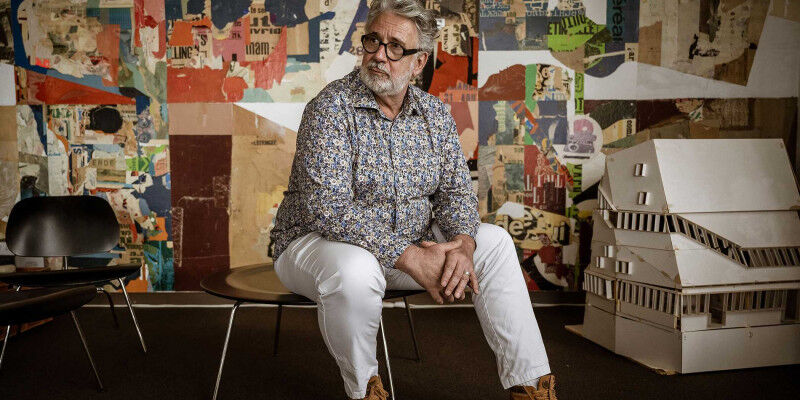
Deplazes could have stayed with Peter Zumthor after completing his degree, but he opted to become self-employed. That’s because while still working on his thesis, he had already won a competition for a school extension project in Alvaschein together with Valentin Bearth. "With a wooden structure, which was still highly unusual back in those days," he remarks.
"It could have gone terribly wrong"
Deplazes had never planned to teach architecture himself - until those around him encouraged him to apply for an ETH professorship. In April 1997, he was invited for an interview in May for a discussion with the President; in July the ETH Board made its decision. After that, he had precisely two months to prepare to face 189 students who were about to knock at his door. "I had no team and no lectures or exercises prepared," Deplazes remembers. "That could have gone terribly wrong, but that’s how I learned to improvise."From the outset, he had one strong architectural guiding principle: It is essential that the concept - developing ideas for a certain spatial context - and the design - the detailing for its structural implementation - are taught as a single entity. "Most students think of the conceptualisation as the creative exercise and the construction design process as the technical assignment. But the latter can be unbelievably exciting and even emotional," he says. Deplazes criticises "expert idiocy" in which technical challenges in architecture are simply delegated away to specialists, calling it "the death of our discipline."
Back when he was preparing his course for design and construction, there was hardly any corresponding teaching material. Civil engineering material was too technical and dry and mainly aimed at engineers. "What I needed was a direct, dialectical connection between ideas and hypotheses on the one hand and their translation into an architectural result on the other," recalls Deplazes. In 2005, the textbook Architektur konstruieren - Vom Rohmaterial zum Bauwerk (Constructing Architecture: Materials, Processes, Structures) was created from files of teaching material he had written himself. Now in its seventh edition, it has been translated into eight languages, establishing itself worldwide as a textbook for universities. For Deplazes, this close dovetailing of design and construction is also a matter of respect for craftmanship. "Whether it’s window makers, carpenters or bricklayers - in Switzerland, there is an incredible variety of highly qualified craftsmen with immense expertise," he explains. "As architects, it is our job to nurture and support this diversity."
Potential of digital technologies
Nevertheless, for Deplazes, tradition and high-tech are not contradictions. He was one of the first architects to integrate robots into the design and construction process. One such design is the new building for the Gantenbein winery in Fläsch with a skin made out of perforated, twisted masonry built with the aid of robots and in collaboration with his colleagues Fabio Gramazio and Matthias Kohler. He also sees great opportunities in VR headsets and augmented reality in which real views are enriched with virtual elements. "In this way, small companies can also perform complex tasks with unskilled workers," he says. "This allows them to compete with high-tech operations."At the same time, he sees great potential for countries where informal construction is the norm, such as in Columbia, where he recently went on a field trip: "Instead of establishing major construction industries, these technologies could also be used in the barrios as a tool to enable locals to build their own houses more smartly and make them more stable and durable."
Digital technologies are also at the heart of Deplazes’ next big project. Together with Spanish architect Francisco Mangado Beloqui, he is currently building the Centro National in Pamplona. The intention for this private architectural school is to provide graduates with in-depth training for two years in all’important digital technologies, including augmented reality, robotics and AI.
"In order to achieve architectural excellence today, young architects must be familiar with these digital tools, but they are no guarantee in themselves."
Students will work on specific assignments from developers responsible for public construction projects in Spain as well as with the construction industry. "In the same way as for the Monte Rosa hut project back then, four studios will each work on a specific case study and develop the projects for several semesters until they reach a more detailed design level," explains Deplazes. The school will be connected to an office where the design process is finalised and made ready for execution - partly by the graduates themselves, who can use this opportunity to find their way into the working world. That’s the idea, at least. The Centro is to serve as a model for the architectural training of the future.
Starting this summer, Deplazes will alternate between his own office in Chur and the Centro National in Pamplona, where he will continue to teach. "I can’t play golf, so I’ll have to find something else to do when I retire," he jokes. At the start of April, a delegation of Spanish politicians and business representatives visited the Institute for Technology in Architecture (ITA) at Hönggerberg, which serves as the blueprint for the Centro’s course of study. During this visit, Deplazes took the opportunity to present the Monte Rosa project again. It fascinates people to this day - even if its creator has long since moved on.
Farewell lecture
On Tuesday, 29 April, at 5.15 p.m., Professor Andrea Deplazes will give his farewell lecture entitled "Aufgebot zur Hausdurchsuchung" (House search warrant) at the Audi Max, ETH Main Building, Rämistr. 101, in Zurich.The event will be streamed live at: https://event.swisscom.ch/v/eth-live-1/live/mainstage