Cheaper solar cells with 20.2% efficiency
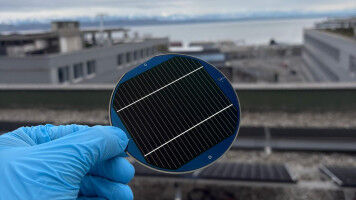
EPFL scientists have developed a solar-panel material that can cut down on photovoltaic costs while achieving competitive power-conversion efficiency of 20. Some of the most promising solar cells today use light-harvesting films made from perovskites - a group of materials that share a characteristic molecular structure. However, perovskite-based solar cells use expensive "hole-transporting" materials, whose function is to move the positive charges that are generated when light hits the perovskite film. Publishing in Nature Energy , EPFL scientists have now engineered a considerably cheaper hole-transporting material that costs only a fifth of existing ones while keeping the efficiency of the solar cell above 20%. As the quality of perovskite films increases, researchers are seeking other ways of improving the overall performance of solar cells. Inadvertently, this search targets the other key element of a solar panel, the hole-transporting layer, and specifically, the materials that make them up. There are currently only two hole-transporting materials available for perovskite-based solar cells.

Links