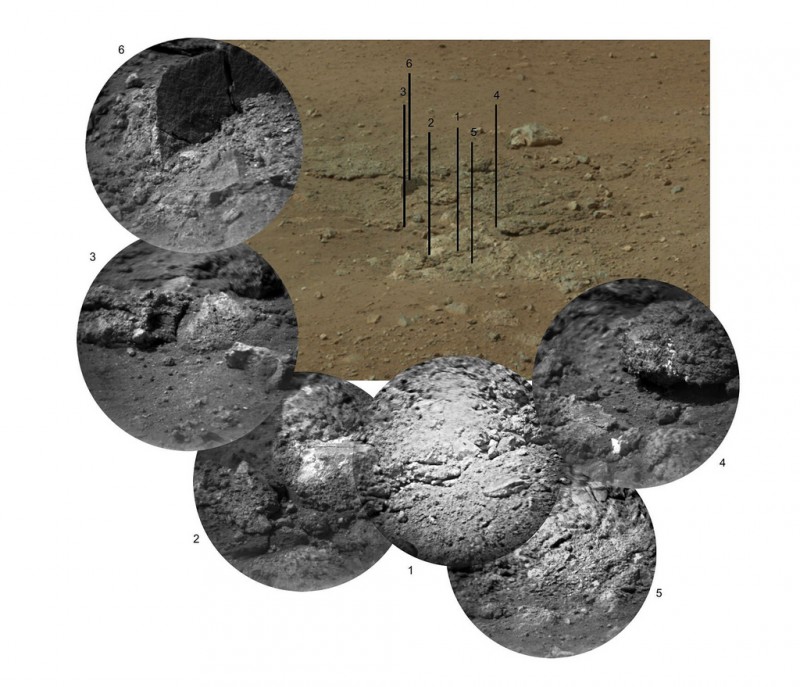
This photo mosaic shows the scour mark, dubbed Goulburn, left by the thrusters on the sky crane that helped lower NASA’s Curiosity rover to the Red Planet. It is located 16 to 20 feet (5 to 6 meters) to the left of the rover’s landing position. The sky crane appears to have uncovered an outcrop of loosely consolidated rocks during the rover’s landing. The mosaic consists of six images from the remote micro-imager (RMI) on the Chemistry and Camera (ChemCam) instrument, shown around an image from the Mast Camera for context. Each RMI image has a field of view of 4 to 5 inches (10 to 12 centimeters) across and shows details as small as 0.02 to 0.03 inches (0.5 to 0.6 millimeters). ChemCam’s laser was used to analyze material at the centers of panels 2, 3 and 4. PHOTO CREDIT: NASA/JPL
The laser instrument has fired nearly 500 shots so far that have produced strong, clear data about the composition of the Martian surface. Curiosity beams back strong, clear data from 'scour' area on Martian surface LOS ALAMOS, NEW MEXICO, August 23, 2012—Members of the Mars Science Laboratory Curiosity rover ChemCam team, including Los Alamos National Laboratory scientists, squeezed in a little extra target practice after zapping the first fist-sized rock that was placed in the laser's crosshairs last weekend. Much to the delight of the scientific team, the laser instrument has fired nearly 500 shots so far that have produced strong, clear data about the composition of the Martian surface. "The spectrum we have received back from Curiosity is as good as anything we looked at on Earth,” said Los Alamos National Laboratory planetary scientist Roger Wiens, Principal Investigator of the ChemCam Team. "The entire MSL team was very excited about this and we popped a little champagne. When ChemCam fires its extremely powerful laser pulse, it briefly focuses the energy of a million light bulbs onto an area the size of a pinhead. The laser blast vaporizes a small amount of its target up to seven meters (23 feet) away.
TO READ THIS ARTICLE, CREATE YOUR ACCOUNT
And extend your reading, free of charge and with no commitment.