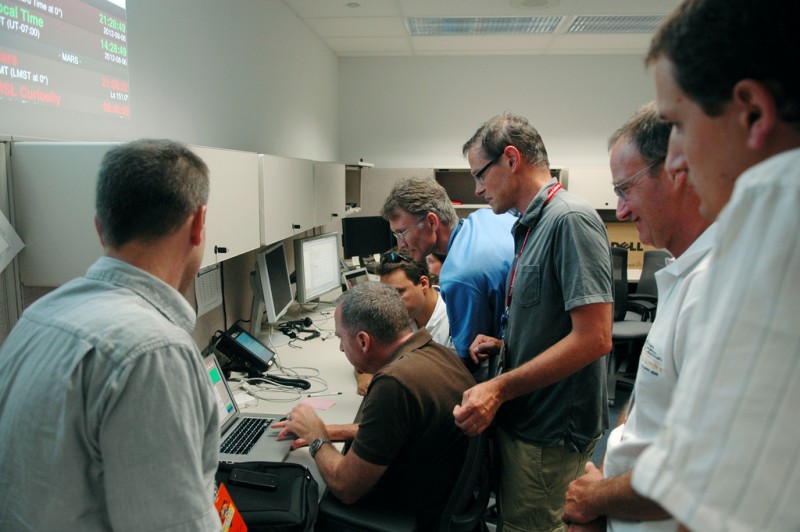
Researchers from LANL and the French Space Agency examine data from the Mars Science Laboratory Curiosity rover from inside the ChemCam Operations Center at NASA’s Jet Propulsion Laboratory on Monday, Aug. 6, 2012, less than a day after the rover landed on Mars. The ChemCam team received signals indicating that the instrument is healthy and all systems are ready to go.
Members of the team got a digital thumbs up about the operational readiness of their instrument just hours after the rover landed on Martian soil. Martian landing area could be a boon for scientific study LOS ALAMOS, NEW MEXICO, August 8, 2012—Members of the Mars Science Laboratory Curiosity rover ChemCam team got a digital thumbs up about the operational readiness of their instrument just hours after the rover landed on Martian soil late Sunday evening. Los Alamos National Laboratory planetary scientist Roger Wiens, Principal Investigator of the ChemCam Team, confirmed that the instrument sent word to its handlers on Earth that it was alive and healthy. "Following the fantastic landing of Curiosity on Mars, ChemCam proceeded with an aliveness test within an hour of landing,” Wiens announced. "This was essentially the same routine as performed five months earlier in the middle of its cruise (to Mars). All systems are go!” The aliveness check means that, as far as the international team of scientists is concerned, ChemCam can begin its next task of transmitting photographic images of the rover as a system check. The ChemCam instrument combines a high-resolution camera powerful enough to view a human hair from seven feet away with a high-power laser that can zap rocks from a distance of as much as 23 feet to determine their composition.
TO READ THIS ARTICLE, CREATE YOUR ACCOUNT
And extend your reading, free of charge and with no commitment.