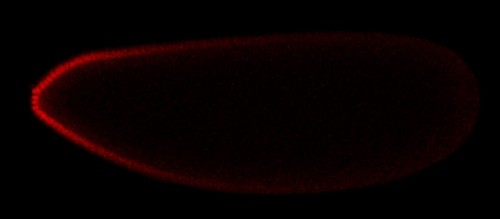
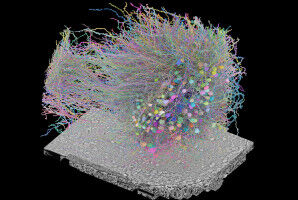
The Princeton team used confocal microscopy to visualize the spatial distribution of two proteins that compete for the MAPK enzyme in early fruit fly embryos. In areas where levels of a protein important for the development of the head were high (shown here in red, with brighter color indicating the presence of more protein) there was less enzyme available to act upon a different protein (shown here in green) that is important for the development of the ends of the embryo, including the tail. (Images: Shvartsman Lab) Images for news media
A Princeton University-led research team has discovered that protein competition over an important enzyme provides a mechanism to integrate different signals that direct early embryonic development. The work suggests that these signals are combined long before they interact with the organism's DNA, as was previously believed, and also may inform new therapeutic strategies to fight cancer. The fought-over enzyme, known as the mitogen-activated protein kinase (MAPK), is found in all complex organisms, ranging from yeast to humans. MAPK signaling pathways, or chemical networks that involve the enzyme, are critical for normal development, and defects in these pathways can lead to severe developmental disorders and cancer. During early embryonic development, a single undifferentiated cell becomes a complex and highly specialized organism containing a variety of different cell types arranged in very precise patterns. These patterns, which ensure that the body structures from head-to-tail and front-to-back develop correctly and in the appropriate places, are created when cells respond to a series of chemical signals from different signaling pathways. The different patterning signals received by any given cell are ultimately combined to govern its future fate and tell it what kind of cell it should become.
TO READ THIS ARTICLE, CREATE YOUR ACCOUNT
And extend your reading, free of charge and with no commitment.